Artist Page: Suki Chan
Suki Chan is a London based artist and film director. Her films take audiences on an immersive journey, and shine a light on subjects that are under-represented across the human condition: from dementia, sight-loss, identity to belonging. Chan’s passion is to change perception and build empathy for other people’s realities.
Chan uses a range of media including installation, moving image, photography and sound to explore our subjective perception of reality. Her mesmerising film works draws the viewer into a cinematic ‘elsewhere’ to investigate memory, belief and knowledge systems.
Chan’s work has been shown nationally and internationally including the Museum of London, David Roberts Art Foundation, London; Centre for Contemporary Chinese Art, Manchester; Liverpool Biennale; Art Basel Hong Kong, Shanghai Museum of Contemporary Art, China; Frost Science Museum, Miami, US; Hiroshima Museum of Contemporary Art, Japan; and Dr. Bhau Daji Museum, Mumbai, India. Chan’s work is included in public and private collections in the UK and USA, including the Museum of London, David Roberts Art Foundation, The Ingram Collection and The Celebrity Art Collection on The Solstice ship.
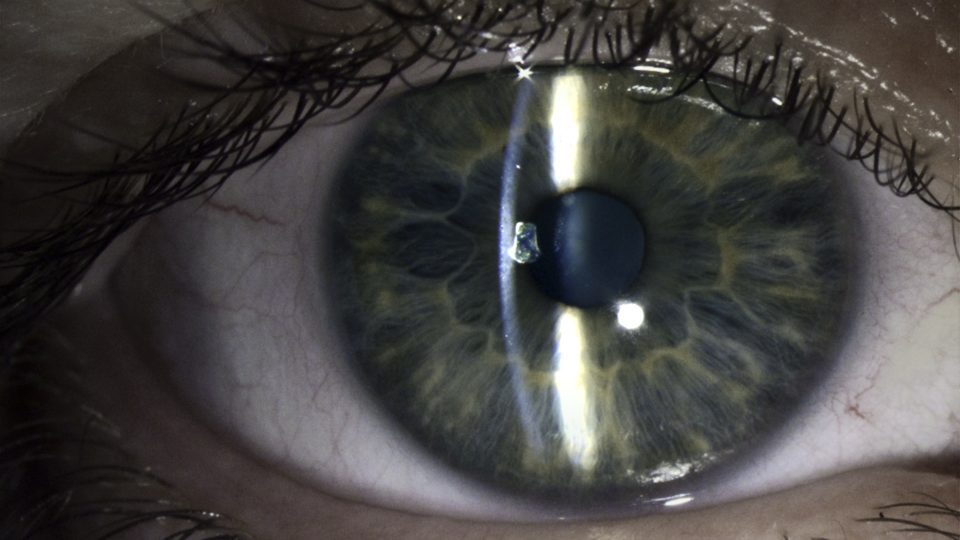
Artist: Suki Chan (b.1977)
Title: Lucida
Year: 2016
Medium: 3 Channel High Definition Interactive Video Installation
Dimensions: Variable
Accession Number: US2017-11
Acquisition info: Lucida was commissioned by the University of Salford with the Centre for Chinese Contemporary Art (CFCCA) in partnership with the Centre for the Study of the Sense, University of London and Tintype. Supported by the Wellcome Trust Small Arts Award and Arts Council England.
Suki Chan is a moving image and installation artist. Her practice combines light, image and sound to explore our physical and psychological experience of time and space. Using meticulously crafted processes and by abstracting familiar materials and objects, Chan creates uncanny narratives that probe the boundaries between private and public space.
Weaving together images of interior architectural spaces, bio-medical research, and individual testimonies about the experience of perception, Chan’s video project Lucida, exposes the curious and complex relationship between the human eye, the brain, and vision. The project takes its name from the ‘camera lucida’, a 19th century optical device used as a drawing aid. Finding parallels between the camera and the way in which images are projected onto the retina of the eye, Chan has created an artwork that attempts to convey how the outside world is processed by the brain. Lucida seeks to make the viewer distinctly aware of the perceptual processes of seeing by bringing those process – including the flaws, imperfections and assumptions – to the forefront.
In Lucida viewers are invited to use eye-tracking technology to reveal their own rapid eye movements – something we are normally unaware of. The multi-screen installation reveals how visual information is modified and processed by the eye and the brain in real time. Lucida is a visceral, visual journey in which Chan’s camera is constantly on the move, restlessly travelling through spaces that lead us, like a thread through a maze, into the heart of her subject. Partially filmed in the University of London’s Senate House, the fluid tracking shots through library spaces and boiler rooms suggest a visual analogy for the interior structures of our eyes and brains.
