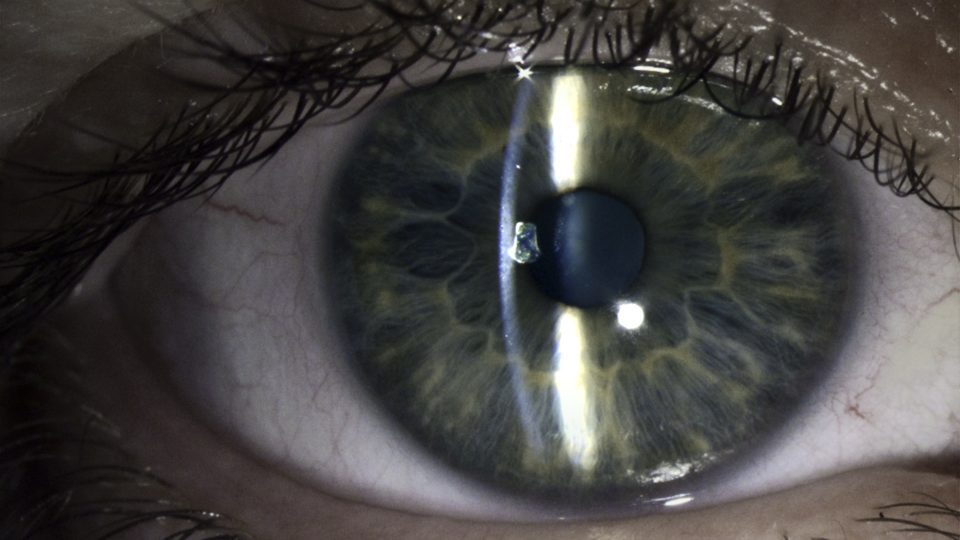
Acquisition info: Elliott Flanagan is a poet, writer and artist. He was born in Burnley, a post-industrial town in the North of England. His work explores class, subcultures, and personal and social histories. A period spent playing football, working in sales and holiday repping contrasted with a ‘hidden pursuit’ of art via film, music, television, fashion, and rare gallery visits. His work is an exploration of the sometimes jarring intersection between these co-existing lives, and an ongoing dissection of contemporary masculinity.
‘A piece of something bigger’ explores contemporary masculinity through the prism of package holiday culture. Flanagan looks at the ideas entrenched in the male gender stereotype that saturated his youth – misunderstood and under pressure to ‘conform and perform’. The artist studies a tension from his own experience between one’s own consciousness and social expectations.
‘The traditional form of masculinity and its lack of complexityis subverted, as the viewer is party to glimpses of real honesty in the chaos. The film discusses the camaraderie that exists in relationships between men and the value of the communal experience therein.’
With music by William Brown and Ashley Snook.
Artist: Joe Fowler
Title: Call to Industry
Year: 2023
Medium: Digital video
Duration: 5 minutes, 5 seconds
Acquisition info:
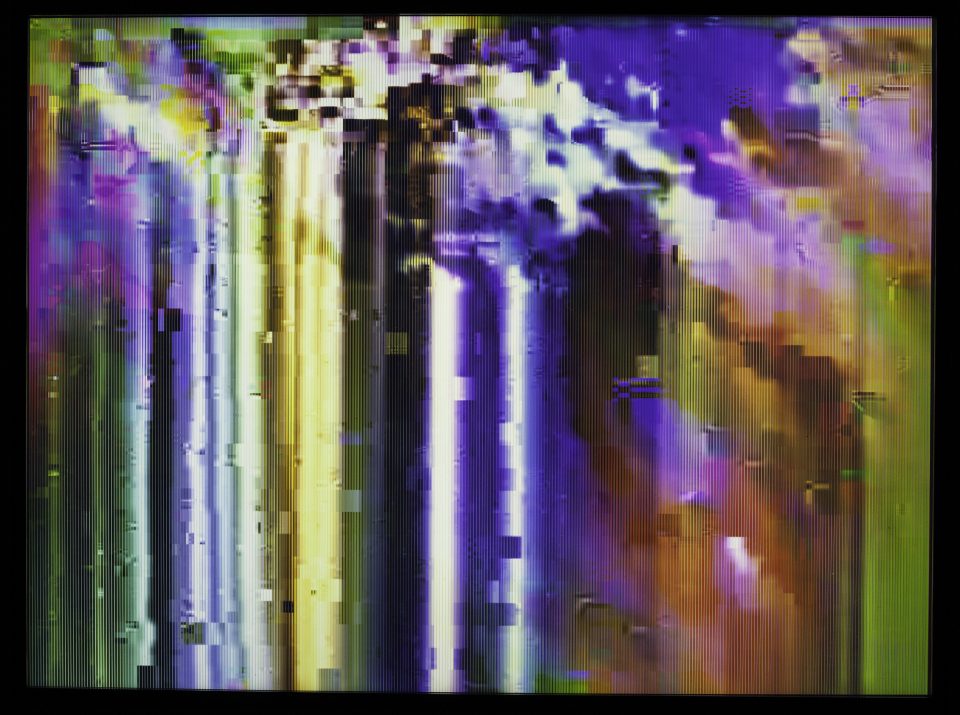
Joe Fowler is a sound artist with a focus on the marriage of data, sound and visuals for the purpose of digital data conservation. His work includes code manipulation, microsound, sonification, and the deliberate corruption of common software. His work has been exhibited in hi-fi contexts such as TEDx and Jodrell Bank, and lo-fi context such as DIY shows at Islington Mill.
‘Call to Industry’ is a ‘tongue-in-cheek exploration of Manchester’s fetishisation of industrial spaces and history, viaa parody cult initiation video for an organisation which worships industry’.
The artist examines the frequent repurpose and reuse of former industrial spaces in the city, which often disregard the dark history of the buildings – including the exploitation and abuse of the working class. He considers the inequalities underlying the Industrial Revolution, which allowed those with enough money and power to continue to exploit those without such privileges. Today, property developers create expensive luxury apartments on the same sites, continuing to lock the working class out of the ability to ‘enjoy the greatest city on earth. Join the cult, worship the ruling class, worship industry…’
Artist: Jack Jameson
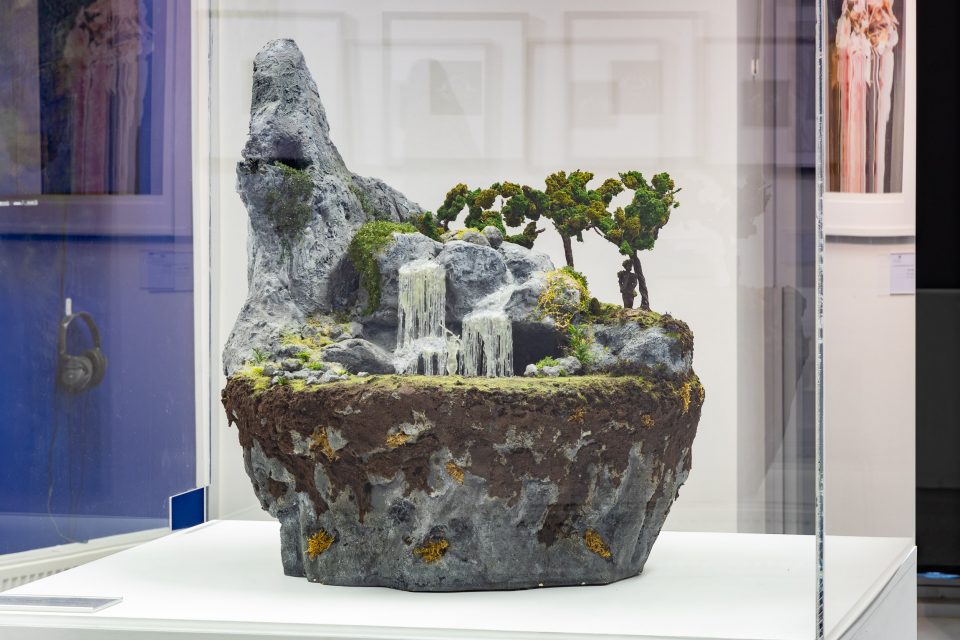
Title: Arcadia; Queer by Nature
Year: 2023 – 2024
Medium: Sculpture and accompanying video
Duration: 4 minutes, 44 seconds
Accession Number:
Acquisition info:
Foraged from scrap, Yet forged into treasure, Here floats Arcadia. A harmonious sanctuary. Where water seeps, rock weathers, And minerals scatter, Sprouting life. Retold in this virtual realm of broken binaries and unbridled fantasy, We prosper in imperfect harmony. Here… We are one.
Jack Jameson’s work presents a model utopia, inspired by mythology and folklore. In this world nature prevails, and the ‘forest nymph, water siren and rock troll dwell in in harmony – free to be’. The work combines craft, costume, 3D scanning, printing and rendering, photography, and animation.
Jameson is a queer multidisciplinary artist who works across physical and digital mediums to depict ‘unworldly narratives of the queer form… with fantastical narratives or comic depictions’. They see their work as a form of gender performance, and draw inspiration from across sci-fi, fantasy, technology, fashion and queer culture. Previous projects include direction, production design and costume for local film projects, music videos, and commercial campaigns.
Artist: Adam Rawlinson
Title: The birds will sing, that you are part of everything
Year: 2024
Medium: Oil on canvas
Dimensions: H: 200cm W: 160cm
Acquisition info:
Rawlinson is an abstract painter primarily working in oils. His work explores the natural world, with a particular focus on lichen – a symbiotic natural organism. He takes interest in their ‘often-unnoticed and underappreciated significance within our ecology, highlighting the extent of our vital relationship with everything that makes up life on earth’.
Using abstraction, gestural mark-making and a range of painterly techniques to ‘give life to’ his paintings, he builds up rich and textural images on large scale canvases. The works seek to manipulate the act and experience of looking; and provide spaces of contemplation and reflection. They form a basis for wider philosophical enquiries, drawing on existentialism and phenomenology, around ‘what it means to be alive’, and what our individual and collective place in the world might be.
Artist: Lizzie King
Title: Belonging
Year: 2021
Medium: C-Type print of 42 individual silver gelatin prints
Accession Number: US2022-04A
Acquisition info:
Lizzie King uses analogue and digital printmaking and photography to explore the ‘narratives of our human-centred universe’. This work was one of two pieces commissioned for Rediscovering Salford in 2020, a city-wide project inviting artists to respond to green spaces in the city.
King focussed on Peel Park and the importance of free and open ‘parks for the people’. Demand for public green spaces traces its roots to the Victorian era, and the park is widely recognised as one of the first ever public parks – and the first to be paid for by public subscription. This importance was heightened during the Covid-19 pandemic: while the artist was shielding it was one of the few safe places to visit.
The park bench became an important symbol of rest, relaxation and reflection: ‘The bench asks nothing of the sitter but ‘to be’’. In this work King reverses the roles – the bench itself becomes the ‘sitter’ of a ‘portrait’. Using an elaborate process of photography, engraving, enlarging and digitally combining 42 original images into one composition, the making of the work itself also became a meditative and reflective process.
Painting in the expanded field, Balshaw’s work extends beyond the traditional bounds and restrictions of painting, exploring the painting as an ‘object rather than an image’. They consider the deconstruction and reconstruction of structures and surfaces, applying and manipulating thick brushes of brightly coloured paint on – and in between – layers of cardboard in abstract gestures.
Their work also considers the intertwined histories of gender and painting practice, where painting is ‘caught up in a push and pull between femininity and masculinity Identifyingas non-binary, I find myself stuck in this whirlwind of tropes, questioning where a painter like me fits amongst the history of painting.’
Mollie Balshaw, Painting Sandwich #7, 2019, Mixed Media.
Courtesy the artist.
Photograph courtesy of Sam Parker.
Mollie Balshaw, Painting Sandwich #5, 2019, Mixed Media.
Courtesy the artist.
Photograph courtesy of Sam Parker.
Artist: Danielle Brathwaite-Shirley
Title: I can’t remember a time I didn’t need you
Year: 2020
Medium: Digital video game
Dimensions: variable
Danielle Brathwaite-Shirley, I can’t remember a time I didn’t need you, 2020, interactive game. Nominated and co-commissioned by Peter Bonnell, QUAD Derby, UK.
We recommend that the game is played on desktop or laptops, rather than mobile phones.
A fog has overtaken a city. Everyone who was in the city has now changed. Word spreads that this fog can support life that isn’t supported on earth. You are going to see if the fog will support your life or if you are the reason the fog has come.
Brathwaite-Shirley (UK) is an artist working predominantly in animation, sound, performance and video games to communicate the experiences of being a Black Trans person. Spurred on by a desire to record the “history of Trans people both living and past” their work can often be seen as a Trans archive where Black Trans people are stored for the future.
Co-commissioned by QUAD, Derby in collaboration with Centre for Chinese Contemporary Art, Open Eye Gallery and University of Salford Art Collection on the occasion of Peer to Peer: UK/HK Online Festival 2020
Click the image or here to launch the game on the Peer to Peer festival website.
Artist: Cecile Elstein (b. 1938)
Title: The Sisyphus Suite
Year: 1979-80
Medium: Series of eight screenprints
Dimensions: Various
Acquisition info:
Cecile Elstein (b. 1938, Cape Town, South Africa) is a printmaker, sculptor, and environmental artist based in Didsbury, South Manchester. In the 1980s, Elstein worked at the Manchester Print Workshop with the Master Printer Kip Gresham. The Workshop was based at the University of Salford until 1985. The Sisyphus Suite joins two works from Elstein already in the Collection made during this time, Small Offering (1980) and A Letter from Mrs Gould (1981).
The Sisyphus Suite was generously gifted to the University of Salford Art Collection from Cecile Elstein Studio Ltd in 2023.
Cecile Elstein, Cover Page from The Sisyphus Suite, 1979-80. Courtesy the artist. Photography by Jules Lister.
Cecile Elstein, Meeting Thanatos from The Sisyphus Suite, 1979-80. Courtesy the artist. Photography by Jules Lister.
Cecile Elstein, Confrontment fromThe Sisyphus Suite, 1979-80. Courtesy the artist. Photography by Jules Lister.
Cecile Elstein, Passion Motivation from The Sisyphus Suite, 1979-80. Courtesy the artist. Photography by Jules Lister.
Cecile Elstein, Decision from The Sisyphus Suite, 1979-80. Courtesy the artist. Photography by Jules Lister.
Cecile Elstein, Journey from The Sisyphus Suite, 1979-80. Courtesy the artist. Photography by Jules Lister.
Cecile Elstein, Construction from The Sisyphus Suite, 1979-80. Courtesy the artist. Photography by Jules Lister.
Cecile Elstein, Resolution from The Sisyphus Suite, 1979-80. Courtesy the artist. Photography by Jules Lister.
Artist: Meg Woods
Title: Condescending Order 1-5
Year: 2015
Medium: Paper Zines.
Dimensions: Multiple, A5
Accession Number: US2015-10
Acquisition info:
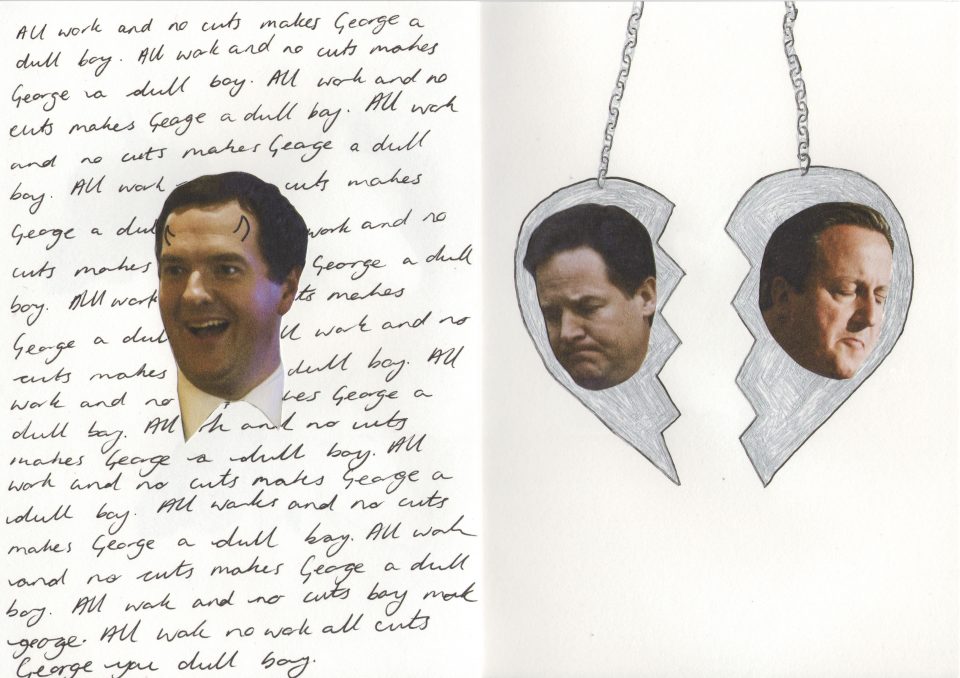
Condescending Order is a series of zines produced on a monthly basis, reflecting current political themes. Usually produced in an A5 booklet format, each zine has a variety of formats including poetry, collage and illustration.
This work was gifted to the University Collection at the culmination of the artists Graduate Scholarship residency programme.
Meg Woods, Condesending Order #1 Cover, Paper Zine, 2015. Courtesy the Artist.
Meg Woods, Condesending Order #2 Cover, Paper Zine, 2015. Courtesy the Artist.
Meg Woods, Condesending Order #3 Cover, Paper Zine, 2015. Courtesy the Artist.
Meg Woods, Condesending Order #4 Cover, Paper Zine, 2015. Courtesy the Artist.
Meg Woods, Condesending Order #5 Cover, Paper Zine, 2015. Courtesy the Artist.
Artist: John Farnham (1942- )
Title: Torso
Year: nd
Medium: Bronze
Dimensions: H: 46.5cm W: 36cm
Accession Number: 134
John Farnham, Torso, sculpture, nd. Courtsey the artist. Photography courtesy Art UK.
Artist: Gwilym Hughes
Title: Salford Faces
Year: 2018
Medium: Giclee Print on Lightbox
Dimensions: H: 130cm W: 90cm D:15cm
Accession Number: US2018-09
Acquisition info:
This work was acquired following the 2018 PRINT UnLtd exhibition, presented at Salford Museum and Art Gallery in partnership with University of Salford Art Collection and Hot Bed Press. Funded by Arts Council England. Hughes was commissioned following selection from an open call for submissions.
Artist: Joey Collins
Title: Gathering of Strangers
Year: 2018
Medium: Screenprint and Graphite
Dimensions: H: 40cm W: 130cm
Accession Number: US2018-11
Acquisition info:
This work was acquired following the 2018 PRINT UnLtd exhibition, presented at Salford Museum and Art Gallery in partnership with University of Salford Art Collection and Hot Bed Press. Funded by Arts Council England. Collins was commissioned following selection from an open call for submissions.
As a starting point for his work for PRINT UnLtd, Collins collected discarded drawings from art supplies shops in Manchester. These drawings are made specifically to ‘try out’ the pens and pencils sold in the shop. In itself, he feels that each of these drawings is its own collaboration; the strips of paper are layered with combined words, squiggles, cartoons, and abstract marks. Collins rescues and recycles these found drawings which he scans, enlarges, edits, separates and exposes onto silk screens and screen-printed. He then works repeatedly into these prints using collage and drawing. Finally, he cuts them into strips, to mirror the original source material, and rearranges the strips into a new piece of work.
Joey Collins is an alumnus of the University of Salford, graduatating from BA Hons Visual Arts in 1997.
Artist: Claudia Alonso
Title: Jackie Kay
Year: 2015
Medium: Photograph
Dimensions: H: 85.5cm W: 99cm
Accession Number: US2015-14
Acquisition info:
This portrait was commissioned by the University of Salford at the installation of Jackie Kay as the new Chancellor. Alonso, then a first year BA Visual Arts student, was selected by a panel for the commission, alongside Rory Mullen (MA Visual Arts). Alonso chose to undertake the photoshoot at the John Rylands Library in Manchester, reflecting on Kay’s background in poetry and literature.
Alonso was born in Spain and studied Graphic Design and Advertising before undertaking Visual Arts at the University of Salford. Photography is at the core of her creative practice, with recent projects also branching out into textiles and printmaking.
Artist: Connal (c.1935 – 1999)
Title: Penninsula
Year: 1970
Medium: Print
Dimensions: H: 58cm W: 72cm
Accession Number: 16
Artist: Joshua Turner
Title: A Seat in the Shade
Year: 2020
Medium: C-type photographic print, hand made by the artist.
Dimensions: H: 50.8cm W: 50.8cm
Accession Number:
Acquisition info:
A Seat in the Shade visually encapsulates a search for solitude in Venice, Italy. The print
was handmade by the artist in the colour darkroom, in an edition of 2. This photograph is
from a larger body of work titled Catch Your Breath, a photobook that was self-published
by the artist in 2020. Catch Your Breath is a meditation on the claustrophobia of Venice,
explored through a combination of photography and literature. This project was conceived
during the 2019 Venice Biennale Steward-Research Fellowship, coordinated by the British
Council.
This peice was gifted to the University Collection at the culmination of the artists Graduate Scholarship residency programme.
Artist: Dan Walmsley and Jai Redman (1971 -)
Title: Jai Redman In the Studio (b)
Year: 2016
Medium: Photograph
Dimensions: Digital Photograph
Accession Number: US2016-16b
Acquisition info:
Photo documentation of creative process behind Engel’s Beard.
Artist: Dan Walmsley and Jai Redman (1971 -)
Title: Jai Redman In the Studio (a)
Year: 2016
Medium: Photograph
Dimensions: Digital Photograph
Accession Number: US2016-16a
Acquisition info: Photo documentation of creative process behind Engel’s Beard
Artist: Alan Whitehead(1952 – )
Title: Litho
Year: 1979
Medium: Lithography Print
Dimensions: H: 102.5cm W: 76cm
Accession Number: T102 [3]
Artist: Paul Ritchie (1948 – )
Title: Intaglio
Year: 1979
Medium: Intaglio Print
Dimensions: H: 86cm W: 69cm
Accession Number: T102 [2]
Artist: Harold Riley (1934 – 2023)
Title: Building by the Railway, Trafford Park – tribute to Edward Hopper
Year: 1976
Medium: Drawing
Dimensions: H: 50.5cm W: 49cm
Accession Number: GMC 1979/20
Artist: Harold Riley (1934 – 2023)
Title: View of the Acme Spinning Mill, from Barton Moss
Year: 1976
Medium: Drawing
Dimensions: H: 39cm W: 40cm
Accession Number: GMC 1979/35
Artist: Harold Riley (1934 – 2023)
Title: Back Entry, Salford
Year: 1975
Medium: Mixed Media
Dimensions: H: 67cm W: 52cm
Accession Number: GMC 1979/40
Artist: Harold Riley (1934 – 2023)
Title: Old Chapel, Broad St, Salford
Year: 1976
Medium: Painting
Dimensions: H: 43.5cm W: 49cm
Accession Number: GMC 1979/42 & 318
Artist: Harold Riley (1934 – 2023)
Title: Window in Chadderton
Year: 1975
Medium: Mixed Media
Dimensions: H: 63.5cm W: 43cm
Accession Number: GMC 1979/27
Artist: Harold Riley (1934 – 2023)
Title: Studies in the Dental Hospital, Manchester
Year: 1978
Medium: Drawing
Dimensions: H: 32cm W: 64cm
Accession Number: GMC 1979/26
Artist: Harold Riley (1934 – 2023)
Title: Study of Colliery, Atherton, Spring
Year: 1969
Medium: Mixed Media
Dimensions: H: 42.5cm W: 44cm
Accession Number: GMC 1979/57 [1]
Artist: Harold Riley (1934 – 2023)
Title: Manchester Docks from Mode Wheel
Year: 1962
Medium: Print
Dimensions: H: 55cm W: 55cm
Accession Number: GMC 1979/P8
Artist: Harold Riley (1934 – 2023)
Title: Boy and Brother in Salford Street
Year: 1977
Medium: Drawing
Dimensions: H: 49.2cm W: 45.4cm
Accession Number: GMC 1979/P5
Artist: Charles Bartlett (1921 – 2015)
Title: MN33
Year: 1970
Medium: Print
Dimensions: H: 72.3 W: 56.5cm
Accession Number: 72
Artist: Walter Kershaw (1940 – )
Title: Scrum Half and Prop Forward
Year: 1970
Medium: Painting
Dimensions: H: 134cm W: 104cm
Accession Number: 74
Artist: Olwen Jones (1945 – )
Title: Over the Hill
Year: 1975
Medium: Drawing
Dimensions: H: 49.5cm W: 62cm
Accession Number: 75
Artist: Richard Riley
Title: Untitled
Year: 1980
Medium: Print
Dimensions: H: 84.6cm W: 69.3cm
Accession Number: T93
Artist: Alan Whitehead
Title: Untitled
Year: 1980
Medium: Print
Dimensions: H: 86cm W: 71cm
Accession Number: T94
Artist: Alan Whitehead
Title: Untitled
Year: 1980
Medium: Print
Dimensions: H: 60cm W: 74.5cm
Accession Number: T95
Artist: Michael Green
Title: Pig Saw
Year: 1979
Medium: Wood Engraving Print
Dimensions: H: 59.5cm W: 86cm
Accession Number: T102 [1]
Artist: Paul Mason
Title: Interior III
Year: 1979
Medium: Lithograph Print
Dimensions: H: 57cm W: 77cm
Accession Number: 294
Artist: Paul Mason
Title: Interior 2
Year: 1979
Medium: Print
Dimensions: H: 57.7cm W: 78cm
Accession Number: 293
Artist: Paul Mason
Title: Lounge 1
Year: 1979
Medium: Print
Dimensions: H: 50cm W: 64.7cm
Accession Number: 295
Artist: Paul Mason
Title: Lounge II
Year: 1979
Medium: Print
Dimensions: H: 58.8cm W: 65.3cm
Accession Number: 296
Artist: Pat Eason
Title: Untitled (Grey) chopped
Year: 1980
Medium: Print
Dimensions: H: 80cm W: 105cm (unframed h 59.3 x w84)
Accession Number: 297
Artist: Pat Eason
Title: Untitled (Pink)
Year: 1980
Medium: Print
Dimensions: H: 80cm W: 105cm (unframed h59.3 x w84)
Title: Salt Box and Skimmer – The Recovery of Dissolved Substances
Year: 1976/1977
Medium: Photograph
Dimensions: Various
Accession Number: 192
Glen Onwin, Red Lion – Salt Box and Skimmer – The Recovery of Dissolved substances, 1976/1977, Copyright Courtesy the artist, Photography by museums Photography North WestGlen Onwin, Red Lion – Salt Box and Skimmer – The Recovery of Dissolved substances, 1976/1977, Copyright Courtesy the artist, Photography by museums Photography North WestGlen Onwin, Red Lion – Salt Box and Skimmer – The Recovery of Dissolved substances, 1976/1977, Copyright Courtesy the artist, Photography by museums Photography North WestGlen Onwin, Red Lion – Salt Box and Skimmer – The Recovery of Dissolved substances, 1976/1977, Copyright Courtesy the artist, Photography by museums Photography North WestGlen Onwin, Red Lion – Salt Box and Skimmer – The Recovery of Dissolved substances, 1976/1977, Copyright Courtesy the artist, Photography by museums Photography North WestGlen Onwin, Red Lion – Salt Box and Skimmer – The Recovery of Dissolved substances, 1976/1977, Copyright Courtesy the artist, Photography by museums Photography North West
Artist: William Home Lizars (1788 – 1859)
Title: Watch mechanism Plate 13 / watch print
Year: nd
Medium: Print
Dimensions: H: 54cm W: 78.8cm
Accession Number: 200
Artist: Bernard Green (1931 – 1998)
Title: Aber Eiddy, Pembrokeshire
Year: 1981
Medium: Print
Dimensions: H: 41.5cm W: 53.5cm
Accession Number: 227
Artist: Clifford Wilkinson (1919 – 2002)
Title: Birds in Flight
Year: 1970
Medium: Print
Dimensions: H: 80.5cm W: 106cm
Accession Number: 79
Artist: Harold Riley (1934 – 2023)
Title: The Greengrocer’s Shop
Year: 1970
Medium: Mixed Media
Dimensions: H: 78cm W: 103cm
Accession Number: 78
Artist: Alberto Giacometti (1901 – 1966)
Title: Atelier 60 (seated man and sculpture)
Year: 1961
Medium: Print
Dimensions:
Accession Number: 66
Artist: Julian Trevelyan (1910 – 1988)
Title: Hindu Temple
Year: 1968
Medium: Print
Dimensions: H: 66cm W: 53cm
Accession Number: 52
Artist: Fernand Leger (1881 – 1955)
Title: La Femme au Foudrier
Year: 1959
Medium: Print
Dimensions: H: 71.6cm W: 56.5cm
Accession Number: 51
Artist: Valerie Thornton (1931 – )
Title: Benham Priory
Year: 1978
Medium: Print
Dimensions: H: 56cm W: 77.5cm
Accession Number: 41
Artist: Alfonzo Padilla
Title: Estudio Raka Reius I
Year: 1968
Medium: Painting
Dimensions: H: 67.3cm W: 56.2cm
Accession Number: 27
Artist: Adrian Ryan (1920 – 1998)
Title: Harlech Castle from Garreg Fawr
Year: 1970
Medium: Painting
Dimensions: H: 90cm W: 111cm
Accession Number: 25
Artist: Dennis Hawkins (1925 – 2001)
Title: Como Se Llama Uds?
Year: 1971
Medium: Print
Dimensions: H: 58cm W: 78.5cm
Accession Number: 4
Artist: Peter Hedegaard (1929 – 2008)
Title: Untitled (abstract)
Year: 1972
Medium: Screenprint
Dimensions: H: 76cm W: 56cm
Accession Number: 143
Artist: Colin T Johnson (1942 – 2017)
Title: Market Scene 2
Year: 1972
Medium: Painting
Dimensions: H: 85cm W: 110cm
Accession Number: 145
Artist: Stanley Reed (1908 – 1978)
Title: L.M. Angus-Butterworth Esq. MA
Year: 1950
Medium: Painting
Dimensions: H: 82cm W: 68.5cm
Accession Number: 147
Artist: Harold Riley (1934 – 2023)
Title: Sketch for Portrait of Chancellor (HRH Duke of Edinburgh)
Year: 1971
Medium: Drawings Charcoal, Ink and Pastel)
Dimensions: H: 82cm W: 69.5cm
Accession Number: 150
Artist: Eduardo Paolozzi (1924 – 2005)
Title: Selesa
Year: 1975
Medium: Screenprint
Dimensions: H: 89cm W: 70.5cm
Accession Number:
Artist: Robyn Denny (1930 – 2014)
Title: Six Miniatures (on Blue)
Year: 1975
Medium: Screenprint
Dimensions: H: 74cm W: 98.4cm
Accession Number: 155
Artist: Robyn Denny (1930 – 2014)
Title: Six Miniatures (on green)
Year: 1975
Medium: Print
Dimensions: H: 73cm W: 98cm
Accession Number: 156
Artist: John Nash (1893 – 1977)
Title: Rendlesham Forest, near Oxford, Suffolk
Year: 1973
Medium: Painting
Dimensions: H: 47cm W: 40cm
Accession Number: 174
Artist: Alan Whitehead
Title: Shoot
Year: 1969
Medium: Print
Dimensions: H: 70cm W: 94.5cm
Accession Number: 18
Artist: Daniel Gleeson (1938 -)
Title: Twigs II
Year: 1971
Medium: Drawing
Dimensions: H: 57cm W: 83cm
Accession Number: 140
Artist: Carmen Gracia (1935 -)
Title: In the Life’s Stream
Year: 1974
Medium: Print, Etching with Embossing
Dimensions: H: 67cm W: 52.5cm
Accession Number: 138
Artist: Dennis Hawkins (1925 – 2001)
Title: Camino Oscuro
Year: 1972
Medium: Screenprint
Dimensions: H: 79cm W: 59cm
Accession Number: 126
Artist: H G James
Title: Salford Cross
Year: 1850
Medium: Lithograph
Dimensions: H: 26cm W: 36.5cm
Accession Number: 118
Artist: Berenice Sydney (1944-1983)
Title: Sky Flight
Year: 1974
Medium: Etching & aquatint
Dimensions: H: 92.5 cm W: 70.5cm
Accession Number: 121
Artist: Dennis Hawkins, (1925 – 2001)
Title: And in the Evening the Ocean Came Towards Them
Stephen Ashdown, Dirt, 2007, print (1 of 4). Courtesy the artist. Photography by Museums Photography North West.Stephen Ashdown, Dirt, 2007, print (2 of 4). Courtesy the artist. Photography by Museums Photography North West.Stephen Ashdown, Dirt, 2007, print (3 of 4). Courtesy the artist. Photography by Museums Photography North West.Stephen Ashdown, Dirt, 2007, print (4 of 4). Courtesy the artist. Photography by Museums Photography North West.
Artist: Antonio Roberts (1985-)
Title: Nodes
Year: 2020
Medium: Digital video and live coded audio
Duration: 4 minuites, 30 seconds
Accession Number:
Acquisition info:
Live coding is a performative practice where artists make music and visual art live using programming. This piece seeks to demonstrate the creative potential of this practice, showcasing two prominent software tools, TidalCycles (music) and Blender (visuals). The title refers to how the live coding community consists of nodes spread across the globe, linked by the software and interest in live coding.
Antonio Roberts (UK) is an artist and curator based in Birmingham, UK, working primarily with video, code, and sound. He is critically engaged with the themes surrounding network culture and in his practice explores how technology continues to shape ideas of creation, ownership, and authorship. As a performing visual artist and musician he utilises live coding techniques to demystify technology and reveal its design decisions, limitations, and creative potential.
Commissioned on the occasion of Peer to Peer: UK/HK Online Festival 2020 by Centre for Chinese Contemporary Art, Open Eye Gallery and University of Salford Art Collection.
Artist: Adrian Henri (1932 – 2000)
Title: Souvenir of Normandy
Year: 1981
Medium: Set of six screenprints
Dimensions: H: 87.2cm W:67.5 cm [For moving image, add duration]
Accession Number: 267 [1-6]
Acquisition info:
The screen-prints were produced at the Manchester Print Workshop which was once based in Salford. The University has a collection of prints from this Workshop, which exemplify the vibrancy of print-making practice in the 1980s.
Adrian Henri, Souvenir of Normandy I, 1981, print. Courtesy the artist’s estate. Photography by Museums Photography North West.Adrian Henri, Souvenir of Normandy II, 1981, print. Courtesy the artist’s estate. Photography by Museums Photography North West.Adrian Henri, Souvenir of Normandy III, 1981, print. Courtesy the artist’s estate. Photography by Museums Photography North West. Adrian Henri, Souvenir of Normandy IV, 1981, print. Courtesy the artist’s estate. Photography by Museums Photography North West. Adrian Henri, Souvenir of Normandy V, 1981, print. Courtesy the artist’s estate. Photography by Museums Photography North West.
Artist: Kip Gresham (1951-)
Title: Lupin Diamond
Year: 1981
Medium: Screenprint
Dimensions: H: 86cm W: 66cm
Accession Number: 274
Artist: Keith Richardson-Jones (1925 – 2005)
Title: Counterpoint 2
Year: 1970
Medium: Screenprint
Dimensions: H: 123.5cm W: 89cm
Accession Number: 165
Artist: Cecile Elstein (1938-)
Title: A Letter from Mrs Gould
Year: 1981
Medium: Screenprint
Dimensions: H: 97cm W: 77cm
Accession Number: 286
Acquisition info:
Cecile Elstein was a member of the Manchester Print Workshop, which opperated out of the University of Salford from the late 1970s until the mid 1980s.
A Letter from Mrs Gould was produced in response to challenging socioeconomic conditions in Manchester and across the UK in the early 1980s. In 1981, Elstein received an unsolicited note signed by an S.Gould, reading:
“Woman needs work urgently – cleaning & domestic work – housekeeping – gardening – handywoman – will do work of any description – hours to suit you – at a rate you can afford….”
Using found papers and materials, Elstein attempted to piece together the circumstances of Gould’s precarious situation: The twenty screen-printed layers include newspaper clippings from the time, netting from a bag of oranges (with a price tag of 50p – showing rising food prices) as well as the envelope in which the letter was received. Elstein intended the final image as a reminder of the dignity, grace and tenacity of “all women involved in real communication”. Both the letter and print make up the collection object.
Acquisition info: Commissioned by the University of Salford Art Collection in 2012.
Artist: James Chadderton
Title: Media City (from the Manchester Apocalyse series)
Year: 2012
Medium: Giclee print
Dimensions: H: 85.8cm W: 105cm
Accession Number: US2012-97
Acquisition info: Commissioned by the University of Salford Art Collection.
Artist: Harold Riley (1934-)
Title: The Christmas Roundabout, Salford
Year: 1980
Medium: Monograph (digital print)
Dimensions: H: 52cm W: 52cm
Accession Number: US2011-5
Artist: Gavin Turk (1967-)
Title: Silver Triple Pop
Year: 2009
Medium: Screenprint
Dimensions: H: 100cm W: 75cm
Accession Number: US2011-8
Artist: Joe Tilson (1928-)
Title: Clip-o-Matic Che (Vallegrande Bolivia, October 10th)
Year: 1969
Medium: Silkscreen with collage on paper, acetate and metalzed polyester
Dimensions: H: 93.5cm W: 72cm
Accession Number: 128
Artist: Gilberte Brilliant
Title: Hausser les Épaules
Year: 1965
Medium: Screenprint
Dimensions: H: 90.5cm W: 71.5cm
Accession Number: 105
Artist: Peter Green (1933-)
Title: Candy Night 1
Year: 1969
Medium: Serigraph print
Dimensions: H: 72.5cm W: 72.5cm
Accession Number: 73
Artist: R. Smallman
Title: Totem
Year: 1970
Medium: Screenprint
Dimensions: H: 71cm W: 51cm
Accession Number: 46
Artist: Liam Young
Title: Where the City Can’t See (Book)
Year: 2017
Medium: Printed Book
Dimensions:
Accession Number: 2017-03f
Acquisition info: Where the City Can’t See was commissioned by Abandon Normal Devices, St Helens Heart of Glass and University of Salford Art Collection. Produced by Liam Young and Abandon Normal Devices, with support from Forestry Commission England’s Forest Art Works and supported using public funding by Arts Council England.
Keywords: Digital, Video, City, Book, Textile
Artist: William Mitchell
Title: Untitled
Year: 1966
Medium: sculpture
Dimensions:
Accession Number: US2017-07
Acquisition info:
Location: Allerton Building, Frederick Road campus, University of Salford Click here for Google maps location
Opened in 1966/67 the Allerton Building was designed by Manchester-based architects’ practice Halliday Meecham. The practice commissioned the London based sculptor William Mitchell to produce a piece of landscape art to provide a point of interest in the courtyard of the building.
The three figures are each positioned ‘so that the morning and evening sunshines will fall on the faces of the figures’.
Though untitled, the sculptures are affectionately known locally as the Minut Men or Faith, Hope and Charity.
The sculptures were Grade II listed in January 2012.
Artist: Karen Lyons
Title: Iron
Year: 2007
Medium: sculpture
Dimensions:
Accession Number:
Acquisition info:
Location: Mary Seacole Building, Frederick Road campus, University of Salford Click here for Google maps location
Clasp was commissioned for the inauguration of the Mary Seacole Building – a place of learning for nurses. Mary Seacole is a heroine of the Crimean War and an iconic figure for the nursing profession.
Clasp represents a nurturing gesture – formed from the interior space when two hands are gently clasped, as if protecting a delicate life.
Produced with assistance by students from Albion High School, Salford.
Made in association with Architects Atherden Fuller Leng.
Artist: Lizzie King and Craig Tattersall
Title: Allerton to New Adelphi
Year: 2015
Medium: C-Type Print of 24 8”X 10” Original Silver Gelatin Prints
Dimensions: 822 x 1685mm
Accession Number: US2015-13d
Acquisition info:
Lizzie King & Craig Tattersall work collaboratively with an emphasis on creating work using analogue photographic techniques, often making work that speaks about the process. Within their artwork there is a strong interest in ephemerality and erasure through repetition. The work tends to acknowledge and reflect upon imperfections and flaws. Through micro detail and emphasis these are brought to the forefront challenging modern ideals of perfection in a digital age. The artists work responsively to the processes they deal with, working with its limitations, not looking to control the process but allow the process to communicate.
Allerton to New Adelphi was a commission for The University of Salford of four C-Type prints from multiple original 8X10″ Silver Gelatin Negatives, depicting the transition of the University’s art facilities from Allerton Studios to the New Adelphi building.
Allerton Studios, Hallway and Studios are three 822 x 1685mm prints taken with a handmade large analogue camera built by the artists. New Adelphi Taken by Allerton is a 2346 x 1076mm print created by turning a room in Allerton building into a camera, projecting the new building into the old, and taking a large negative. The print depicts the construction of New Adelphi and shows it in its place within Salford and into Manchester.
Lizzie King and Craig Tattersall, from left to right: Allerton Studios, Hallway and on bottom: New Adelphi Taken by Allerton. Images courtesy of the artists.
Artist: Rachel Goodyear
Title: Unable to Stop because they were too close to the line
Year: 2006
Medium: Limited edition prints from original drawings
Dimensions: variable
Accession Number: US2013-2
Acquisition info:
Known for her dark humor, broadly monochromatic palettes, and fantastical motifs— which include blood, animals, masks, and carcasses— Rachel Goodyear describes her drawings as an exploration of “desire, fear, greed, envy, and deceit.” Of her practice she observes, “[My drawings of animals] are more human than most, while the people that I draw are starting to become more feral as their social boundaries begin to drop away.” Though Goodyear usually works in small formats, she has recently begun to work on a larger scale, and also produces porcelain sculptures. She counts the filmmaker David Lynch among her major influences.
(source: Islington Mill)
UNABLE TO STOP BECAUSE THEY WERE TOO CLOSE TO THE LINE is a collection of drawings commissioned by LIME. It is a reflection of a 6 month period of chemotherapy where the artist and patient are one and the same. This was an unusual project in that as a patient I was experiencing the illness and treatment, and as an artist I was standing outside of myself and observing what was happening. This dual existence is expanded in this text by the interruptions of extracts from my diaries shown in italics. These texts drifting off at a tangent reflect my regular escapes into a visual world of fiction throughout the whole experience.
(source & full artists’ statement on Rachel Goodyear website).
Rachel is a long-term studio holder at Salford studios Islington Mill, and recently became a Board member and co-Director. She is represented by Pippy Houldsworth Gallery, London.
Dimensions: Approx. 5m x 4.5m. Weight approx. 2.5 tonnes
Accession Number: US2016-17a
Acquisition info:
Engels’ Beard is a sculpture and also a unique bouldering wall at the heart of the University of Salford’s Peel Park campus. The artwork was unveiled on 22 September 2016 and was commissioned by the University through the art policy relating to the New Adelphi building, the new home for the School of Arts and Media.
The Engels’ Beard project was several years in the making and began in 2014 when the University commissioned Salford based arts production company Engine (Jai Redman and Ian Brownbill) to make the sculpture as part of the public realm work surrounding the New Adelphi building. The idea had existed for much longer – Jai and Ian had come up with the idea with their former business partner Simon Chislett, after reading Manchester, England by former Haçienda DJ, Dave Haslam. Haslam referred to a failed plan in the mid 1980’s to relocate a statue of Friedrich Engels from an unspecified former Eastern bloc country to Manchester City Centre.
Engels had written The Condition of The Working Class in England after observing the conditions of people living in slums in Salford and Manchester in 1845. It is also rumoured that he drank in the Crescent Pub, Salford, with Karl Marx, with whom he later wrote The Communist Manifesto.
Jai and Ian formed Engine in 2014 in order to deliver more ambitious public art projects made ‘with people, rather than at people’. Finally they have been able to realise their ambition to celebrate the work of Friedrich Engels. They have focussed on his signature beard as a symbol of wisdom and learning, while the climbing aspect came from the desire to make the sculpture an interactive artwork.
Jackie Kay, Chancellor and Writer in Residence at the University of Salford, and Scottish Makar wrote the poem Thinker in response to the sculpture – the last lines are incorporated into the landscaping surrounding the sculpture.
Jackie Kay, Thinker, 2016
The ground beneath our feet
may give way at any minute
so we climb to try and find
you, who holds the small key
to the brain in winter or spring,
the way reality holds imagining,
a struggle for a shorter day
when the nights come in
shifts, dusk to dawn
dawn to dusk, stars stitched –
workers are not machines
students are not shoppers
we stand on your shoulders
on your acts of kindness
and you pass down this puzzle
that cannot be solved, ever:
the three great levers
heave the world out of joint
Made from layered newspaper and bamboo, Gordon Cheung’s window installation series ‘Home’ refers to homes in China with traditional window lattice designs that were demolished due to rapid urbanisation. The sculpture hovers between states of being, suggesting a ghost architecture that would have supported the windows. They act as a demarcation between the march of unstoppable progress, and the framework of identity, history and culture that define the individual.
‘Home’ premiered at Edel Assanti Gallery London (2019) in a solo show by the artist. The exhibition draws together three years of research and creation; addressing the emerging science fiction realities surrounding China’s vast infrastructural expansion – from dystopic surveillance societies to the formation of unfathomable megalopolises of 130 million citizens via the fusion of what are already the world’s largest cities.
Cheung graduated with a Bachelor of Fine Arts in Painting in 1998 from Central Saint Martins College of Art and Design in London and earned his Masters of Fine Arts in 2001 from the Royal College of Art in London. Select solo shows include Jack Shainman Gallery in New York, The Four Horsemen of the Apocalypse, The New Art Gallery Walsall, Walsall UK.
Artist: Owen Leong
Title: Hole
Year: 2006
Medium: Digital print
Dimensions: 110 x 140cm
Accession Number: US2019-01
Acquisition info:
During a residency in Manchester in 2006, Leong borrowed aristocratic costumes from Manchester theatres, to explore connotations of class and status – continuing a wider body of work which examines systems and symbols of representation, power, identity and culture. The small hole digitally created on the figure’s wrist suggests a ‘rupture’ in our expected perceptions of identity – who is this figure and what positions of authority or status may they possess?
Chinese-Australian artist Leong works in performance, photography, sculpture and video. He has exhibited widely in Australia and internationally, including solo exhibitions at Artereal Gallery, Sydney (2021) and group shows at: Nillumbik Prize for Contemporary Art, Melbourne (2021), Newcastle Art Gallery (2019) and Art Central Hong Kong (2017).
This work was gifted from the artist and the CFCCA archives in 2019.
Artist: He Xiangyu
Title: Untitled (yellow abstract)
Year: 2018
Medium: Giclee print
Dimensions: tbc
Accession Number: US2019-03
Acquisition info:
Untitled (Yellow Abstract) is part of He Xiangyu’s ongoing Lemon Project, which considers the use, perception and representation of yellow and lemon across 24 countries, including China, Nigeria, New Zealand, Japan and the UK. Through the project, he shows that the etymology of ‘yellow’ and ‘lemon’ are entwined historically across cultures, as well as having symbolism that transcends borders of language, culture and religion. Through a series of yellow abstract paintings and prints, Xiangyu explores how the colour has been used as a symbol of peace, violence, life, and death. Specific examples of use from both East and West include political weapons, border indicators, freedom, liberation, and funeral motifs. For example – yellow was used in the Umbrella and Sunflower movements in Hong Kong and Taiwan, as well as having widespread used for representing liberal parties in Europe and South America.
He Xiangyu’s experimental practice can be seen as both a material testing ground and conceptual laboratory that investigates diverse personal, social and political themes. Part of a generation of Chinese artists who grew up during a period of rapid urbanisation he has said that “I’m seeking to adjust and guide people’s perception through the material changes within the object”, using a range of media to reflect on philosophical ideas such as the increasing materialism and obsolescence of our society as well as the effects of the institutionalisation and commercialisation of contemporary art. (Biography: Courtesy White Cube).
Xiangyu studied at Shenyang Normal University in 2008. He has held numerous international group and solo shows, and is represented by White Cube gallery. This print was acquired after Xiangyu’s solo show at CFCCA in 2019.
Artist: Liang Yue
Title: untitled
Year: 2018
Medium: Photograph triptych
Dimensions:
Accession Number: US2018-07a
Acquisition info:
The ‘everyday’ is a focus in Liang Yue’s photographic and video practice. She uses the easy-to-get materials with her acute art talents, keeps seeking, exploring and capturing the daily routines.
A clear clue of her art practice could be witnessed in the works produced during the past fifteen years where the beauty of insignificance is explored. In these works, Liang keeps simplifying and abandoning the techniques of shooting and editing, challenging the art appreciation which the audience has been used to, as well as the viewers’ retina and eardrum, patience and rationality. Subsequently, Liang further questions the so-called significance and value of art as she treats the meaningless as the ultimate significance of her creation.
Adapted from http://www.shanghartgallery.com/galleryarchive/artists/name/liangyue)
In April 2018, Liang Yue undertook a short residency in Liverpool; although this was her first visit to the city, it appeared strangely familiar to her. The Pier Head reminded her of the Bund back in Shanghai, ‘the noise of traffic, running up and down near the dock, and the smells …are redolent of Huangpu River’.
The works made during Liang’s residency featured in the This is Shanghai exhibition (14 July – 7 September 2018) at the Cunard Building, Liverpool. Presented by Culture Liverpool in partnership with Open Eye Gallery, This is Shanghai explored and celebrated the relationship between Liverpool and its twin city in China. The University of Salford acquired three of Liang’s works, from This is Shanghai. Each of the works focuses upon the River Mersey; in video piece C0018 and Liang’s untitled triptych the River appears tranquil as its delicate fine ripples flicker under the sunset. These ripples from the River are then replicated in the surface of the sandbank where two seagulls are observed in video piece C0011.
Liang Yue graduated from the Shanghai Art Academy in 2001. Recent exhibitions include This is Shanghai, Cunard Building, Liverpool, UK (2018); The 7th edition Bi-City Biennale of Urbanism/Architecture, Shenzhen (2017); Intermittent, ShanghART Beijing, Beijing (2016); Easy Going, OCT Contemporary Art Terminal, Shenzhen (2014); Liang Yue: The Quiet Rooms, ShanghART H-Space, Shanghai (2013); A Lecture Upon the Shadow, Open Eye Gallery, Liverpool, UK (2012); Numerous, Liang Yue’s Solo Exhibition, Shanghai (2011); Move on Asia, the End of Video Art, Casa Asia-Barcelona, Barcelona, Spain (2011); Shanghai Candid: Women In Motion, San Francisco Arts Commission Gallery, USA (2010); China Power Station – Part IV, Pinacoteca Agnelli, Torino, Italy (2010); Shanghai Kino, Shanghai Kino, KUNSTHALLE BERN, Switzerland (2009); China Power Station: Part II, Astrup Fearnley Museum of Modern Art, Oslo, Norway(2007); China Power Station: Part I., Battersea Power Station, London, UK (2006).
Commissioned by Liverpool City Council in partnership with University of Salford and Open Eye Gallery, Liang Yue presented her series of works in This is Shanghai exhibition (14 July – 7 September 2018) alongside the Liverpool Biennial 2018.
Artist: Chen Ching-Yuan
Title: the (flare-s)
Year: 2013
Medium: Installation – Single channel video with boat sculptures
Dimensions: Variable
Accession Number: US2015-17
Acquisition info:
Chen Ching-Yuan’s works focus on the dilemma of the unstable and feeble perceptions generated when one has to face an uncontrollable and tremendous pressure. Working in a variety of different media, including painting, video and installation, Chen Ching-Yuan often uses visual metaphor to articulate the ambiguity and perplexity of national politics and internal reflections of identity.
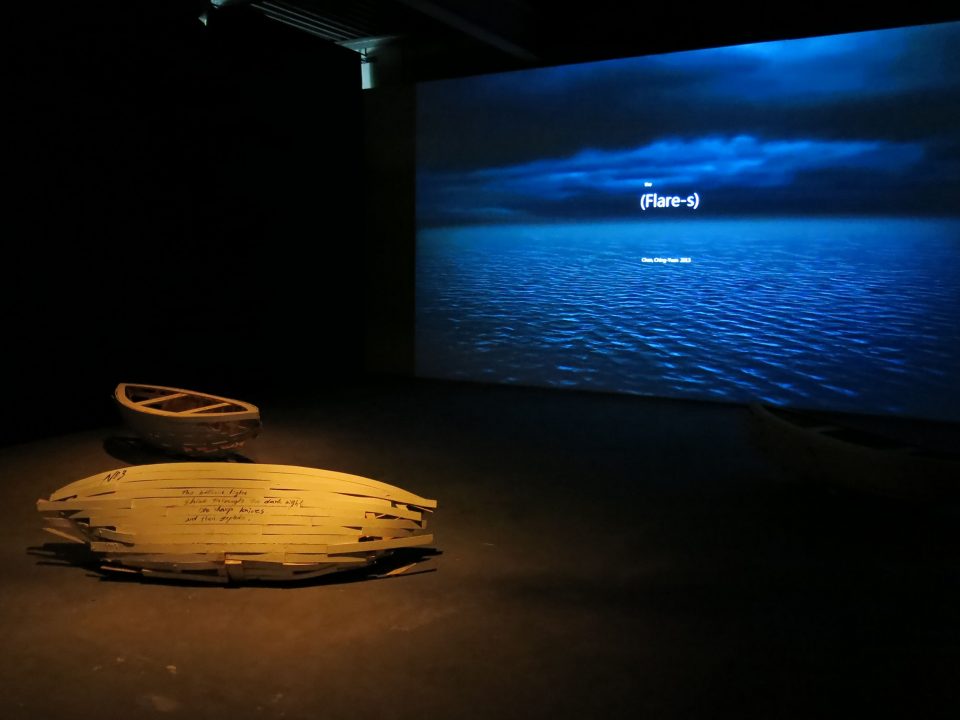
the (flare-s) enjoyed a UK Premiere in 2014 in Harmonious Society, a major exhibition curated by Centre for Chinese Contemporary Art (CFCCA) (with support from the University of Salford) as part of Asia Triennial Manchester, 2014. The artwork is is an installation made up of a looped animation and worn lifeboats that are illuminated at intervals by spotlights. The animation shows a sea at night where waves constantly sound and wooden boats drift into view. A lone figure occupies each boat and they take it in turns to send rescue signals up into the night sky. As help fails to come, more and more flares are ignited, the sound of rockets exploding creating an unsettling cacophony: these signs and sounds of crisis paradoxically become celebratory fireworks as the boats sink. Ching-Yuan’s animation work focuses on the dilemma of misunderstanding and the terror of being faced with uncontrollable and unstable situations.
Chen Ching-Yuan, the (flare-s), 2013. Installation photograph at St. George’s Hall by Pete Carr.
Exhibitions include: PRESENCE: A Window into Chinese Contemporary Art, St. George’s Hall, Liverpool (2018); unfinished portrait, mor charpentier, Paris, France (2018). What am I? If I can’t be yours, TKG+, Taipei, Tawain (2016); Un title, ITPark, Taipei, Tawain (2015); (flare-s), TKG+, Taipei, Tawain (2013).
Yang Yongliang was trained as a pupil to traditional Chinese painting and calligraphy since early childhood, he later graduated from China Academy of Art in Shanghai in 2003, majoring in Visual Communication. Yang Yongliang exploits a connection between traditional art and the contemporary, implementing ancient oriental aesthetics and literati beliefs with modern language and digital techniques.
Mountains of Crowds is a HD video made in 2016. Yang Yongliang uses images of architecture as brushstrokes; heavy mountain rocks with enriched details draw a faithful reference to Song Dynasty landscape painting. Urban development makes life in the city flourish, but it also imprisons these lives; centuries-old cultural tradition in China is profound, but it has also remained stagnant. Ancient Chinese people painted landscapes to praise the greatness of nature; Yang’s works, on the other hand, lead towards a critical re-thinking of contemporary reality.
In Mountains of Crowds, Yang features a large crowd of people in a busy city centre. As it occurs in urban life everyday, the crowd is seen as a part of the landscape. They move faster and faster, people submerge in each other until they gradually become blurry, and even invisible. However, despite the change in the crowd, the mountains stay still.
Mountains of Crowds exhibited as part of group show Digital Matters: The Earth Behind the Screen at the Centre for Chinese Contemporary Art, Manchester (November 2017 – February 2018). In November 2018, the work will exhibit in Acquired: a century of collectingat Salford Museum and Art Gallery.
Yang Yongliang’s work has been exhibited internationally at museums and biennials, such as Thessaloniki Biennale in Greece (2009); Ullens Center for Contemporary Art in Beijing (2012); National Gallery of Victoria in Melbourne (2012); Moscow Biennale (2013); Metropolitan Museum of Art New York (2013); Daegu Photo Biennale in Korea (2014); Singapore ArtScience Museum (2014); Modern Art Museum Paris (2015); Kunst und Kultur in Neuried e.V (2015); Fukuoka Asian Art Museum (2015); Somerset House London (2016, 2013); Art Gallery of New South Wales in Sydney (2016, 2011). His work has also been collected by more than 20 public institutes including the British Museum; Brooklyn Museum; How Art Museum in Shanghai; the Metropolitan Museum of Art in New York; Museum of Fine Arts Boston; San Francisco Asian Art Museum and University of Salford Art Collection.
Mountains of Crowds was purchased with support form Art Fund and in partnership with CFCCA.
Artist: Lu Yang
Title: The Great Adventure of Material World #1
Year: 2019
Medium: Digital print on archival paper, mounted to aluminium
Dimensions: 130 x 150cm
Accession Number: US2019-04
Acquisition info:
Lu Yang is a Shanghai-based multimedia artist who creates fantastical, often morbid and shocking visions of death, sexuality (or a-sexuality), mental illness, and neurological constructs of both real lifeforms and deities. Deeply immersed in the subcultures of anime, video games, and sci-fi, Lu Yang’s output spans 3D-animated films, video game-like installations, holograms, neon, VR and even software manipulation, often with overt Japanese manga and anime references. Her works involve frequent collaborations with performers, designers, experimental composers, robot companies, and idol stars.
Lu Yang has been featured in major exhibitions at venues such as the UCCA, Centre Pompidou, MAXXI National Museum of XXI Arts. She has also participated in numerous Biennales such as: Shanghai Biennale, (2018 and 2012), Athens Biennale (2018), Liverpool Biennial (2016), Montreal International Digital Art Biennial (2016), 56th Venice Biennale, China Pavilion (2015), and Fukuoka Asian Art Triennale (2014).
The Great Adventure of Material World #1 was commissioned for PHOTOFAIR Shanghai 2019, as part of the UOSAC exhibition Taking the Leap, guest curated by Ying Kwok. Read more about the exhibition here.
Image Courtesy of the artist.
Lu Yang, The Great Adventure of Material World #1, 2019. Digital print, on archival paper mounted to aluminium. Image courtesy of the artist.
Artist: Lu Xinjian
Title: City DNA/Salford and Manchester
Year: 2016
Medium: Acrylic on canvas
Dimensions: Approximately 140 x 200cm
Accession Number: US2015-20
Acquisition info:
Lu Xinjian’s art and design practice hovers between representation and abstraction, aiming to convey the historical evolution of cities and their structures.
City DNA/Salford and Manchester presents a graphic view of the topography from the University of Salford campus to Manchester city centre, where the Centre for Chinese Contemporary Art (CFCCA) is located. Working from aerial views from Google Earth, the painting began as a series of sketches, which were then made into a stencil using Adobe Illustrator. The final design of lines, curves, squares and circles was hand-painted. What is given in lieu of an accurate cartography is a sense of place – the vibe, rhythm or tempo of the area where Salford and Manchester meet. It was also made into a pink and blue wallpaper for CFCCA.
City DNA/Salford and Manchester is part of a larger body of work, which includes views of Beijing, Amsterdam, Groningen, New York, Shanghai, Hong Kong and Paris. This work is unique in its presentation of two city spaces.
This was an important moment for me, back several years ago when I was asked by the University to add a piece to their collection, and painting the CITY DNA/Salford and Manchester piece. Although I had begun to grow in recognition in Asia, this was one of the first times I had been asked by an institution in the UK to be part of their collection. Lu Xinjian.
Recent exhibitions include: PRESENCE: A Window into Chinese Contemporary Art, St. George’s Hall, Liverpool (2018); Reflections, ART LABOR Gallery, Shanghai, China (2017); Lu Xinjian: City DNA + Reflections, Fabien Fryns Fine Art, Marbella, Spain (2017); Infinite Lines, de Sarthe Gallery, Beijing, China (2017); City DNA / Jiang Nan, Matthew Liu Fine Arts, Shanghai, China.
City DNA/Salford and Manchester was co-commission with the Centre for Chinese Contemporary Art (CFCCA) to celebrate both our partnership as well as CFCCA’s 30th anniversary in 2016.
Artist: Yan Xing
Title: Letter to Mr Robert Peckham
Year: 2012
Medium: Digital print (limited edition of 20)
Dimensions: 26 x 40 cm
Accession Number: US2014-4
Acquisition info:
Yan Xing is best known for his performance, video, and installation works that are often underpinned by elaborate, eccentric and fictional back-stories. This Limited edition print represent a thank you letter from the artist to an Asia-based curator, Robin Peckham. Although Peckham is a real person and the statement is signed by the artist, it is unclear whether the circumstances described in the artwork are a true reflection of Yan Xing’s situation in 2012. That year, he had his first UK solo show at Centre for Chinese Contemporary Art (CFCCA), Manchester, won the Chinese Contemporary Art Award for Best Young Artist Beijing; received a nomination for the Future Generation Art Prize from the Pinchuk Art Centre, Kiev; and was a finalist in the Focus on Talents Project from Today Art Museum, Beijing.
Letter to Robert Peckham reads: ‘At this occasion, I would like to thank Mr. Robin Peckham, who helped me when I most needed encouragement and made me persevere more strongly. I think it was a particular stroke of good luck to have encountered him at a time in 2012 when I was suffering the greatest hardship. As I conclude, I should therefore like to convey my gratitude to him in this special way’.
Exhibitions include: PRESENCE: A Window into Chinese Contemporary Art, St. George’s Hall, Liverpool (2018); Dangerous Afternoon, Kunsthalle Basel, Basel, Switzerland (2017); Archive 56: Yan Xing, Video Bureau, Guangzhou, China/Beijing, China (screening) (2016); Yan Xing, Eli and Edythe Broad Art Museum, Michigan State University, USA (2016); Nuit et brouillard, Galerie Urs Meile, Lucerne, Switzerland (2016); Performance of a Massacre, Stedelijk Museum Amsterdam, Amsterdam, Netherlands (2016).
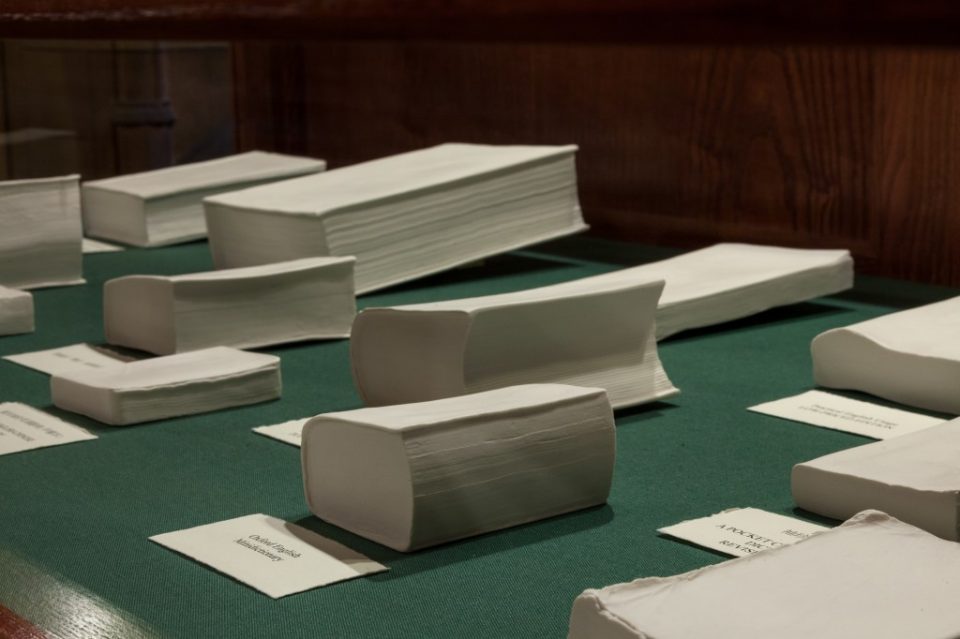
Dimensions: Variable (18 small book-sized sculptures)
Accession Number: US2015-1
Acquisition info:
Annie Wan Lai Kuen is a Hong Kong-based ceramic artist. She takes everyday objects as her subject matter and transforms them into beautiful objects injected with meaning.
Lost in Biliterate and Trilingual comprises 18 small porcelain sculptures, each taking the form of a dictionary. The work was originally exhibited at the Harmonious Society exhibition at the John Rylands Library, Manchester, curated by Centre for Chinese Contemporary Art (CFCCA) as part of Asia Triennial Manchester 2014. The title of the artwork refers to the language policy adopted by the Hong Kong government after the handover of the territory from the United Kingdom to the Chinese in 1997, which has meant that Cantonese, English and Mandarin all feature in Hong Kong political and daily life. In order to create this work, the artist took moulds from her own dictionary and those belonging to her friends; the resulting casts capture the bent spines, battered corners and creased covers of the books. However, in porcelain form, these sculptural books cannot be opened and remain mute, perhaps suggesting the limitations of translation and communication, or acting as monuments to the analogue world.
Annie Wan Lai Kuen holds a Master of Fine Arts from Chinese University of Hong Kong, a Bachelor of Arts in Fine Arts from Chinese University of Hong Kong, and a Higher Certificate in Studio Ceramics from Hong Kong Polytechnic University, in addition to a Diploma of Design. She is currently Assistant Professor of the Academy of Visual Arts of the Hong Kong Baptist University.
In 2019, Wan will be exhibiting in a group show at Echigo-Tsumari Art Triennale, Japan. Previous exhibitions include: ZaanBakFo, Cheung Hing Grocery Store, Hong Kong (2018); PRESENCE: A Window into Chinese Contemporary Art, St. George’s Hall, Liverpool (2018); Composing Stories with Fragments of Time, Karin Weber Gallery, Hong Kong (2017); Collecting Moonlight, performingART project, Oil Street Art Space, Hong Kong (2017); Evolving Images – Modern Hong Kong Printmaking, Sun Museum, Hong Kong (2017); What’s In Store?, Salford Museum and Art Gallery, Salford, UK; Flight, Feathers and Quilt, University of Salford, Salford, UK (2016).
Chi-Tsung is concerned with the poetics of nature and the intersection of traditional art forms and contemporary technology. Wrinkled Texture 027 re-interprets traditional Chinese landscape painting (Shan shui). Exploring the textures of mountain terrains, the flows of rivers and water, or celebrating the quiet beauty found in nature, Shan shui paintings traditionally offer a subjective view of nature, while demonstrating the artist’s calligraphic skill. In Wrinkled Texture, Chi-Tsung takes an innovative approach to Shan shui, by working with the photographic ‘cyanotype’ technique. Covered in photosensitive solutions, rice paper sheets were folded and reshaped while being exposed to sunlight for thirty minutes. After the paper was washed, the creases, lines and folds were fixed as an abstract image of blue hues and textures, akin to mountain precipices and cliffs. Substituting ink washes and calligraphic lines with experimental photographic techniques, the artist reinterprets the imaginary landscapes of ancient Chinese culture.
Wu Chi-Tsung, Wrinkled Texture 027, 2015. Cyanotype. Installation shot at St. George’s Hall, Liverpool. Photograph by Pete Carr.
Wu received his Bachelor of Fine Arts from the Taipei National University of the Arts in 2004. He has exhibited widely in Taiwan and across China. Sponsored by Taiwan’s Ministry of Culture, his work first toured the UK in a solo show in 2014, delivered by a partnership programme between the Centre for Chinese Contemporary Art, Live at LICA, Lancaster and Site Gallery, Sheffield. In 2014, he was listed as one of the top 10 artists under 35 by the international website Artsy. Exhibitions include: PRESENCE: A Window into Chinese Contemporary Art, St. George’s Hall, Liverpool (2018); Far from East, Kϋnstlerhaus Bethanien, Berlin, Germany (2017); Inward-scape, Galerie du Monde, Hong Kong; Dust, Site Gallery Sheffield, UK; Recalibrate, Peter Scott Gallery and The Storey, Lancaster, UK (2014).
Totem Recollection 3, 2007, presents a near-lifesize female figure partially dressed in the green uniform of the Chinese Communist Party lying on a field of badges depicting Chairman Mao. The image evokes the suffering of those who experienced the Cultural Revolution, and the ways in which individual identity was drowned in a sea of propaganda. In the contrast between the erotic pale flesh of the figure and the incessant, overwhelming figure of Mao, Tain evokes the experiences of a generation of people, whose youth and energy was curtailed according to the demands of the Party. Although her chest is exposed, the woman covers her face with her hand, conveying, perhaps, a desire to lay bare her identity while ever conscious of the need for self-censorship.
‘The Cultural Revolution was an age of madness when females were completely masculinised with a phony propaganda appearance. I use the female nude to reveal basic physical and material desires, mocking the imprisonment of humanity that occurred during the Cultural Revolution when people were arbitrarily killed for random reasons. No respect was paid to human dignity, human rights, or life. The liveliness and sacredness of human life is a topic I seek to express through the depiction of female nudes in my work’. Source: Interview with artist Tian Taiquan with OCULA magazine
Tian graduated in 1988 from the Sichuan Fine Arts Institute. Exhibitions include: PRESENCE: A Window into Chinese Contemporary Art, St. George’s Hall, Liverpool (2018); Perspectives, Art Plural Gallery, Singapore (2015); Tian Taiquan:Memory of Time, Hayward Fine Art, Brisbane, Australia (2013); TotemRecollection, Tian Taiquan Photographic Exhibition, Hong Kong, (2012); 7010 – Life After People, Chongqing, China (2010).
The Fog Series represents a common motif in Ma Qiusha’s work: windows. She sees them symbolically as a barrier, but at the same time a channel to understand the outside world.
From a distance the 3 panels of Fog Series appear to be monochromatic, however, on closer inspection, the dark surfaces are seen to be floral patterned and translucent, and rather than being inscribed onto the surface, the lines are in fact gaps between the areas of paint, revealing the underlying surface of the paper. This contrast between the delicate and domesticated, with the harsh sharpness of the black and white markings echo the ideas of Ma Qiusha’s work beautifully. Although better known as a multimedia artist, Ma’s Fog Series demonstrates her sensitivity to ordinary objects and the ways in which everyday materials may be emotionally charged. Ma used a lace curtain as a stencil, applying layers of paint to the fabric so that its pattern would be present but hidden on the paper. This painting explores the suppressed emotions experienced by many of her generation, as they seek to balance familial duties with a wish for personal freedom. The harsh white lines at once suggest a violent rupture and a fragile gesture of individuality.
Ma Qiusha graduated from Digital Media studio of The Central Academy of Fine Arts. Beijing, China in 2005 and completed an MFA in Electronic Integrated Art, Alfred University, New York, United States in 2008. Recent exhibitions included: Joint exhibition History Repeats Itself, with artist Shen Xin at Middlesbrough Institute of Modern Art, Middlesbrough, UK (2018); PRESENCE: A Window into Chinese Contemporary Art, St. George’s Hall, Liverpool (2018). Recent exhibitions include Beijing Commune at Art Basel in Hong Kong (2017); Ma Qiusha: Wonderland, Beijing Commune, Beijing, China (2016); Not Early Not Late, Pace Gallery, Beijing, China (2016).
The core of the Some Days series is based on the artist’s memories of childhood and family, Chinese culture, and the Cultural Revolution, which have been interpreted and abstracted to read at a level of collective consciousness. Through these photographs, Wang Ningde has reordered his experiences and given them a new form, creating a surreal world that lies somewhere between reality and memory. This dream-like imagery is only heightened by the fact that all of Wang Ningde’s subjects have their eyes shut, as if they are meditating or reminiscing. The mood throughout Some Days is melancholic and introspective, and while the photos may feel like scenes from a silent movie, the personalities of the subjects themselves are impossible to read. In Wang Ningde’s world, individuality is stripped away, as is the real moment in time when the photograph was made. With an acute sensitivity, the artist is able to recreate and distill his past from the inside out.
In Some Days No. 03 a man dressed in a collared jacket stands with his arms folded across his chest. His held tilts gently to one side, while a long cigarette is held gently between his lips. His eyes are closed, and it would seem that he is asleep. Behind him, the sky is filled with billowing clouds, creating a dream-like setting. The man, although physically present, is also elsewhere, lost in his own private thoughts, dreams, or memories. The photograph, Some Days No. 03 gestures toward unfulfilled yearnings, longings and desires and suggests that outward appearances can only ever give a partial glimpse of the person within.
‘Good art, according to Wang Ningde, is about casting a ray of illumination. He hopes his series, Some Days, will in some way bring about a moment of clarity for the audience, not by providing easy, ready-made answers, but by aiding the individual in the processes of thought and imagination, remembrance and understanding. It is only through comprehension of ourselves and our own histories that Wang Ningde believes individual diversity can be guaranteed’. Source: http://wangningde.com/article/1035
Wang Ningde graduated from the photography department of the Lu Xun Academy of Art in 1995. After graduating, he moved to southern China where he worked for a decade as a photojournalist during the period of China’s explosive economic and cultural transformation. Departing from documentary photography, Wang returned to his northern hometown to began his Some Days series, which he worked on between 1999 and 2009’. Source: https://www.artspace.com/wang_ningde
Recent exhibitions include: Form of Light, Bryce Wolkowitz Gallery, New York, USA (2018); PRESENCE: A Window into Chinese Contemporary Art, St.George’s Hall, Liverpool (2018); No Name, PHOTOFAIRS, Fort Mason Festival Pavilion, San Francisco, USA (2017); No Name, PHOTOFAIRS, Shanghai Exhibition Center, Shanghai, China (2016) and Form of Light, Paramount Pictures Studios, Los Angeles, USA (2015).
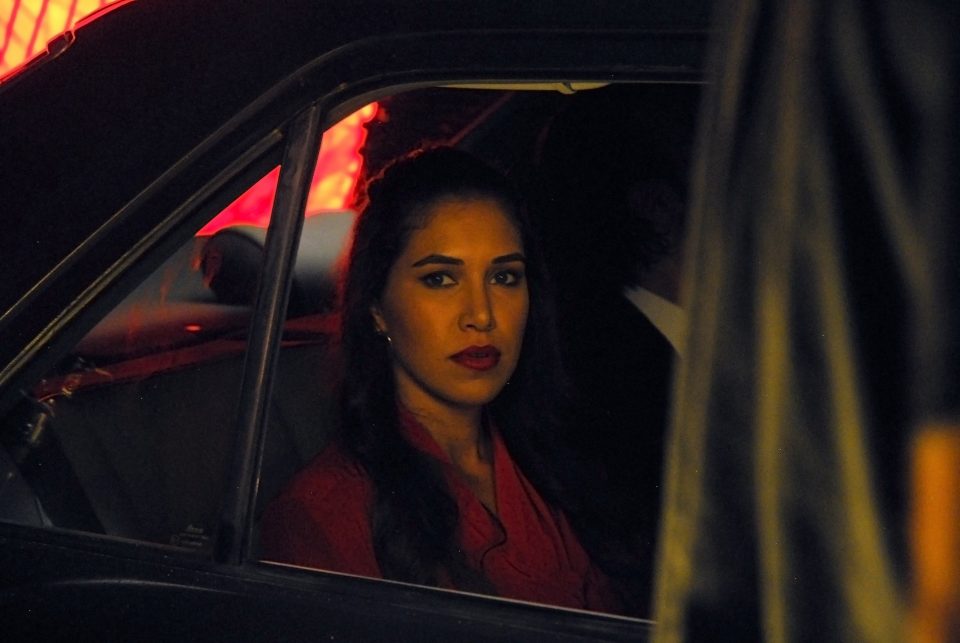
Weaving together conspiracy, gangster, noir, politics, crash theory, fantasy and reality, The Scar sees four unlikely associates – Yenge, the former beauty queen, state assassin Reis, anxious politician Ağa and chief of police Kaptan – sharing a car, headed along a mysterious road and bound together by power and corruption.
The story unfolds over three films and through Yenge’s narrative, culimating in a powerful and intriguing glimpse at a world breaking free of the patriarchy through a gender revolution.
The Scar is commissioned by FLAMIN Productions through FILM LONDON Artists’ Moving Image Network with funding from Arts Council England in partnership with HOME & no.w.here with support from University of Salford Art Collection, Spectre Productions, Delfina Foundation, Centre national des arts plastiques France, Edith-Russ-Haus Germany, and àngels barcelona.
susan pui san lok is an artist, researcher and writer based in London. Projects range across installation, moving image, sound, text and performance – evolving out of interests in notions of nostalgia and aspiration, place and migration, translation and diaspora.
RoCH Fans and Legends is a body of work that draws on over forty different film, television, anime and comic book adaptations of The Condor Trilogy, a series of books written by Jin Yong (Louis Cha) and published between 1957 and 1961. The series is regarded as a classic of the ‘new wuxia’ (martial heroes) genre of Chinese literature, which follows the adventures of martial artists in ancient China. The project title derives from the second book The Return of the Condor Heroes (1959), while also referring to the proliferation of bootlegged and on-line films supplemented by fan-generated translations, overdubbing, and subtitles; not to mention the fan-fiction extensions to the series. Collating various scenes, moments and moving images, lok considers the recurring tropes and motifs that have survived in each new articulation of the series – the fantasies, legends, and archetypes.
RoCH Fans and Legends premiered at QUAD, Derby (November 2015) and was exhibited at CFCCA, Manchester 30th anniversary exhibition (2016).
Artist susan pui san lok, Trailers (from ROCH fans and legends). Installation photograph at St. George’s Hall Liverpool. Photographer Pete Carr.
Commissioned by the University of Salford Art Collection with the Centre for Chinese Contemporary Art (CFCCA) in partnership with QUAD, Derby and Animate Projects.
Artist: Kong Chun Hei
Title: Hand Practice
Year: 2017
Medium: Digital video
Dimensions: 48m 45s
Accession Number: US2017-05
Acquisition info:
Drawing is the starting point of Kong Chun Hei’s artwork and although he also utilises video, animation, sculpture and installation, all relate back to the processes of drawing. In Hand Practice the artist presents the hand exercises that he uses when preparing to create his careful and detailed drawing works. The exercises look deceptively simple, but become difficult over long periods of time, highlighting the physical strength and mental capacity required for his drawing practice. Kong is most well-known for his work in pen and black ink that capture the surfaces of ordinary objects, often mimicking different material textures. Kong has suggested that “His work has no great meaning,… his aim is just learning how to see in an age when the only thing certain is uncertainty.”
Kong created this work while he was Artist in Residence at Centre for Chinese Contemporary Art (CFCCA), Manchester; the work was then displayed as part of group exhibition co curated by Lindsay Taylor (UoS), Ying Tan (CFCCA) and Ying Kwok (Independent curator, Hong Kong) From Ocean to Horizon (July – October 2017).
Kong Chun Hei graduated from the Fine Arts Department of The Chinese University of Hong Kong in 2009. Exhibitions have included: PRESENCE: A Window into Chinese Contemporary Art, St. George’s Hall, Liverpool (2018); Synthesis, New Adelphi Exhibition Gallery, University of Salford, Salford, UK (2017); Stay away from those rocks, Gallery EXIT, 3/F, 25 Hing Wo St, Aberdeen, Scotland, UK (2017); Kong Chun Hei: Back unsay shades can go, ASIAN NOW, Paris, France (2016); Back And Forth // Left And Right, Artissima 2014, Torino, Italy (2014).
Title: Freud’s House: The Double, and Freud’s House: The Double Mirror.
Year: 2016
Medium: Digital video, Installation.
Dimensions: Variable.
Accession Number: US2015-18
Acquisition info:
Work commissioned and acquired by University of Salford’s Commission to Collect Programme.
Artist: Patrick Hughes
Title: Wet Rainbow
Year: 1979
Medium: screenprint
Dimensions: 75 x 57.7
Accession Number: 187
Acquisition info: Purchase.
Hughes work explores perception and illusion. In the 60s and 70s he developed his ‘rainbow’ series “A rainbow is a transitory event composed of water, air and light. I tried to give it a mass, permanence and personality.” He is also well known for inventing the ‘reverspective’ a type of 3D painting or print which offers an optical illusion to a viewer moving past.
Acquisition info: Gift from Edward Glennon, 2012. Supported by the ArtFund.
Albert Adams, Self Portrait (recto), 1958, Woodcut. Image Courtesy the Artist Estate. Photography by Museums Photography North West.
Artist: Jesse Glazzard
Title: LGBT+ Letters
Year: 2018-19
Medium: Series, Film Photographs accompanied by letters from the subjects.
Dimensions:
Photographs: W: 59.4 cm, H:8 4.1 cm, each accompanied by an A4 letter.
Accession Number:
Acquisition info:
Jesse’s own coming-out at secondary school was fraught with the fear, and harsh reality, of violent backlash. But it was also hampered by what Glazzard saw as a complete lack of queer visibility. He had simply no experience of how tobecomequeer. Glazzard’s first cultural experience of queer romance was of a single ‘chaste, lesbian kiss’ on the popular soap operaEastEnders at the age of 9.
While LGBTQI representation in popular culture has improved, Glazzard describes still seeing many stale stereotypes, which this photographic work seeks to rectify. LGBT+ Lettersis an attempt at providing, through portraits and texts, queer aesthetics for people who find themselves without meaningful representation in the world. In the photography series, Glazzard demonstrates a lack of self-indulgence rather a strong belief in accommodating to his subjects’ individualities, and ultimately to build trust, capture intimacy, educate and inform.
The LGBT+ Letters series was gifted to the Collection at the culmination of the artists time on the Art Collection’s Graduate Scholarship Programme, run in partnership with Castlefield Gallery.
Portraits:
Jesse Glazzard, Ella (from LGBT+ Letters), 2018-2019. Courtesy the artist.
Jesse Glazzard, Blake (from LGBT+ Letters), 2018-2019. Courtesy the artist.
Jesse Glazzard, Jay (From LGBT+ Letters), 2018-19. Courtesy the artist.
Jesse Glazzard, Lua (From LGBT+ Letters), 2018-19. Courtesy the artist.
Jesse Glazzard, Meggie (From LGBT+ Letters), 2018-19. Courtesy the artist.
Jesse Glazzard, Laurie (From LGBT+ Letters), 2018-19. Courtesy the artist.
Jesse Glazzard, Weimen (From LGBT+ Letters), 2018-19. Courtesy the artist.
Acquisition info: Gift from Edward Glennon, 2012. Supported by the ArtFund.
Albert Adams, The Circus (Portfolio of Artists’ Proofs) A, 2006, Print. Image Courtesy the Artist’s Estate. Photography by Museums Photography North West. Albert Adams, The Circus (Portfolio of Artists’ Proofs) B, 2006, Print. Image Courtesy the Artist’s Estate. Photography by Museums Photography North West. Albert Adams, The Circus (Portfolio of Artists’ Proofs) C, 2006, Print. Image Courtesy the Artist’s Estate. Photography by Museums Photography North West. Albert Adams, The Circus (Portfolio of Artists’ Proofs) D, 2006, Print. Image Courtesy the Artist’s Estate. Photography by Museums Photography North West. Albert Adams, The Circus (Portfolio of Artists’ Proofs) E, 2006, Print. Image Courtesy the Artist’s Estate. Photography by Museums Photography North West. Albert Adams, The Circus (Portfolio of Artists’ Proofs) F, 2006, Print. Image Courtesy the Artist’s Estate. Photography by Museums Photography North West. Albert Adams, The Circus (Portfolio of Artists’ Proofs) G, 2006, Print. Image Courtesy the Artist’s Estate. Photography by Museums Photography North West.
Acquisition info: Gift from Edward Glennon, 2012. Supported by the ArtFund.
Albert Adams, The Circus (Portfolio) A, 2006, Image Courtesy the Artist’s Estate. Photography by Museums Photography North West. Albert Adams, The Circus (Portfolio) B, 2006, Image Courtesy the Artist’s Estate. Photography by Museums Photography North West. Albert Adams, The Circus (Portfolio) C, 2006, Image Courtesy the Artist’s Estate. Photography by Museums Photography North West. Albert Adams, The Circus (Portfolio) D, 2006, Image Courtesy the Artist’s Estate. Photography by Museums Photography North West. Albert Adams, The Circus (Portfolio) E, 2006, Image Courtesy the Artist’s Estate. Photography by Museums Photography North West. Albert Adams, The Circus (Portfolio) F, 2006, Image Courtesy the Artist’s Estate. Photography by Museums Photography North West. Albert Adams, The Circus (Portfolio) G, 2006. Image Courtesy the Artist’s Estate. Photography by Museums Photography North West.
Artist: Thomson & Craighead
Title: Corruption I & II
Year: 2014
Medium: Photographic lightbox print
Dimensions: h42.5 x w56.5 x d11.5
Accession Number: US2014-8
Acquisition info: Purchased in 2014
Corruption I and Corruption II are from an edition of twelve photographic light boxes each displaying twelve frames taken from a corrupt video file found online – a file intended to put a virus onto the downloader’s computer but which appears pixilated, painterly and abstract when opened in a video player. In searching out these glitches, malfunctions and distortions, the artists represent them as aesthetic propositions, reminding us that the act of looking itself distorts our perception of reality. Lenticular printing enables the artists to show multiple images that animate as the viewer moves in space. They do not ‘playback’ or move automatically.
Artist: Mishka Henner
Title: Selfie
Year: 2017
Medium: Reflective dye sublimation print on aluminium
Dimensions: 215 x 337 mm
Accession Number:
Acquisition info: Purchased in 2021 to celebrate the launch of Energy House 2, University of Salford.
Henner’s practice ‘navigates through digital terrain to focus on key subjects of cultural and geo-political interest – often reflecting on cultural and industrial infrastructures.
To make Selfie, the artist zoomed all the way out from their studio address in Manchester on Google Earth – and then zoomed out even further. Using an intentionally reflective surface, the viewer finds their own image superimposed on the small earth – especially when taking a photo or selfie. The artist comments: “With your reflection in the picture, this is you, the world, and everything you’ve ever known”.
Selfie was acquired to mark the launch of Energy House 2.0, a world-leading new facility on campus. It is display alongside other works chosen from the Art Collection, which all consider how we use technology to understand the world around us. The University Collection also includes two earlier works by Henner, Wasson Oil and Gas Field, Yoakum County, Texas (2013-14) and Cedar Point Oil Field, Harris County, Texas (2013-14)
Part of our About the Digital collection strand.
About the artist: Born in Belgium in 1976, Henner now lives and works in Greater Manchester. He exhibits nationally and internationally, and has work held in public and private collections.
Acquisition info: Gift from Edward Glennon, 2012. Supported by the ArtFund.
Artist: SHARP
Title: Dancing with Elvis
Year: 1999 – 2021
Medium: Photographic print
Dimensions:
Accession Number:
Acquisition info: Gifted by the artist in 2021. SHARP studied at the University of Salford the late 1990s.
Dancing with Elvis are a set of 4 photographs that were taken within a space of Queer reflection afforded by the home studio environment of SHARP’s Manchester council tower block flat. These resulting works sit somewhere between self-portraits and still lives and present SHARP’s queer gaze upon themselves via the television screen. Mirrored via Elvis is a masculinity, a butchness and a queerness which is overt and desired and is situated within SHARP’s everyday life.
The period of the 1990’s was the decade in which people lived under Section 28 which criminalised the ‘promotion of homosexuality’. This was a period of censorship in terms of visibility and representation of Queer identity. SHARP’s butch dyke and non-binary identity is not something that was available via mainstream media or even within their art education and so they created out of necessity as a personal exploration. This set of 4 photographs are split into 2 pairs. The first pair which show Elvis on an old TV set within a darker deep red surround are the original prints from their Salford University degree show in 1996. The second pair were reprinted in 2021 and show Elvis in a cowboy hat surrounded by a softer pinker light which floods the still drawn makeshift curtains. Dancing with Elvis are a part of a larger Queer archive of photographic works by SHARP spanning 4 decades.
Artist: Albert Adams
Title: Study for Two figures at Rondebosch Fountain
Acquisition info: Gift from Edward Glennon, 2012. Supported by the ArtFund.
Artist: Parham Ghalamdar
Title: Birds or Borders
Year: 2020
Medium: Animated video
Dimensions: 6m12s
Accession Number:
Acquisition info: Co-commissioned for the Collection during the first Covid-19 lockdown, in collaboration with Castlefield Gallery. Watch the full video, and read an Q&A with the artist, here.
“Birds or Borders explores the medium of expanded painting and drawing, and responds to the context of Covid 19 lockdowns. Each of us experienced a unique context in lack of freedom of movement: people were not authorized to leave their houses. However the restriction of movement is nothing new. Asylum seekers, refugees, immigrants and people holding week passports have been dealing with life-threatening forms of such limitations; Trump’s travel ban is perhaps an radical example of it. Hopefully this situation would result in having more sympathy with each other”.
Trained as a painter, Chen’s practice has included drawing, painting and paper-cut alongside video, photography and installation. His works deal with issues of commercialization, globalization, environmentalism and changing cultural values.
Fu Lu Shou comprises three orange paper-cuts, each presenting a different Chinese character. Collectively, the characters stand for the Three Stars of Fu (Luck), Lu (Prosperity) and Shou (Longevity), in traditional Chinese culture. Papercutting has a long history in China, and has traditionally been a vernacular art form, often used decorate the home, and with particular patterns used for weddings and other special occasions. Although declining in popularity, Chen sought to utilise the practice of papercutting in his own practice in a way that reflected and commented upon contemporary society. Within the borders of these characters are the linear forms of global brand names and logos, including Gucci, Holiday Inn, Prada, Cartier and Coca-Cola. Including these symbols of global consumerism within the confines of vernacular Chinese visual culture, Chen considers the intersection of these two cultural systems and wonders whether they are mutually exclusive, or whether they might co-exist?
The three characters stand for Three Stars in the traditional Chinese culture, which are the personified ideas of Prosperity, Status and Longevity. The pattern has been replaced with brand logos and icons, which are reflecting the values and visions are subtly changed in the modern day Chinese society… Chen Hangfeng.
Solo exhibitions have included: All that glitters must be gold, CFCCA, Manchester, (2013); The Asian Carp – Chen Hangfeng solo project, AM Art Space, Shanghai (2015); Endless Demand, Cable Gallery, Helsinki (2013).
This work was acquired into the University of Salford Art Collection through a fund collected by the Salford Business School, to honour the retirement Patrick Trodden after 35 years as lecturer.
Fu, Chen Hangfeng, 2013. US2015-15a. Courtesy the Artist. Photography by Museums Photohgraphy North West.
Lu, Chen Hangfeng, 2013. US2015-15b. Courtesy the Artist. Photography by Museums Photohgraphy North West.
Shou, Chen Hangfeng, 2013. US2015-15c. Courtesy the Artist. Photography by Museums Photohgraphy North West.
Acquisition info: Gift from Edward Glennon, 2012. Supported by the ArtFund.
Artist: Han Feng
Title: Shoe for Bird
Year: 2012
Medium: Mixed media sculpture
Dimensions: 60 x 185cm
Accession Number: US2013-05
Acquisition info:
I want to make a bigger, prettier and more disturbed virtual world. My work is about dream-making, about the story of navigating and searching in a paradoxical world. Han Feng
Han Feng’s practice spans painting, sculpture, installation and mixed media. Through the Shoes for Birds series, Feng imagines how birds might respond if given choices of the human world. If birds wore shoes what type of shoes would they wear? On the one hand, Han Feng’s Shoe for Bird may be understood as a quirky and lighthearted investigation into this ‘what if…’ question. A white leather, lace-up boot is the answer given. But this surreal object should not be taken at face-value, and like much of his work in painting and installation addresses broader issues including the opposition between the organic or natural, and the man-made; and the nature of freedom and constraint. The artist explains:
These shoes and clothes for birds are a metaphor. They reflect the human world, I would like to raise the question that if we were all birds whether we would choose to fly or sacrifice our natural ability to fly, in order to put on a glamorous outfit.
Han Feng attended the Art Institute of Harbin Normal University, before graduating with an MA from Art Institute of Shanghai University. He won the Grand Jury Award in the 2008 Annual Creative New Artists Competition, M50 Art Gallery, and the First Prize in the John Moores Contemporary Painting Prize (China) 2010. Britain’s Saatchi Gallery and Japan’s Aichi Triennial both exhibited major works of Han Feng in 2013.
Han Feng has had solo exhibitions at ShanghART, Beijing, China (2017); CFCCA, Manchester, UK, 2012; Aroundspace, Shanghai, 2011; Flying circles, MOCA, Shanghai, 2010; Don Gallery, Shanghai, 2009.
Chou Yu-Cheng specialises in the interplay between aesthetics and society. His practice place a conceptual emphasis on the procedure and operations behind his projects in their specific contexts, reflecting on the problems of reality and proffering alternatives to their corresponding benefits, organisations and histories. As a conceptual artist Yu-Cheng is concerned with the systems and mechanisms of the art world. Acting as an intermediary, much of his work engages with institutions, art’s histories, and audiences, and not only seeks to reinterpret how and why artworks are displayed, but also to intervene in the gallery space itself.
Chou’s from Geoff MolyneuxSeries, is a response to work by the Manchester-based painter Geoff Molyneux (b.1951) who Chou met when on residency at Centre for Chinese Contemporary Art (CFCCA) in 2013. Chou plays with Molyneux’s abstract geometric painting, including repeating a particular colour used on the canvas as a background. In this display, Molyneux’s original painting is divorced from the time and place in which it was made – and cumulatively Chou proposes how the mechanisms for the display and contextualization of art may be questioned.
Chou Yu-Cheng, from Geoff Molyneux Series. PRESENCE exhibition installation shot by Pete Carr.
Chou Yu-Cheng studied at l’Ecole Nationale Superieure des Beaux-arts de Paris. He has exhibited widely across the world and recent solo shows include exhibitions at Museum of Contemporary Art Denver, Colorado; Galerie Collet Park, Paris; Taipei Fine Art Museum, Taipei; Kaohsiung Fine Art Museum, Kaohsiung and Edouard Malingue Gallery, Hong Kong. Group exhibitions include: PRESENCE: A Window into Chinese Contemporary Art, Liverpool, UK (2018); Share, Create, Unite, The Physics Room, Christchurch, New Zealand (2017); Tropical Cyclone, Kuandu Museum, Taipei, Taiwan (2017); What’s in Store?, Salford Museum & Art Gallery, Manchester, UK (2017); Art, Ask About Asia, Daegu Art Factory, Daegu, Korea (2017); Asian Art Biennial, National Taiwan Museum of Fine Arts (2015); The Great Ephemeral, New Museum, New York, USA (2015); Queens International 2013, Queens Museum, New York, USA (2013); Aerobraking, Pier 2, Kaohsiung, Taiwan; Taipei Biennial 2012, Taipei Fine Art Museum (2012).
Much of Luke Ching’s photographic artwork explores the processes of urbanisation, charting the changing face of the cities in which he has worked. In January 2017, Ching undertook a 10-day residency in Liverpool, transforming a hotel room in the Titanic Hotel (a 200 year old former warehouse), Stanley Dock, into a camera obscura, or pin-hole camera. In the darkened space of room 118, Ching placed a grid of A3 light sensitive paper on the wall, opposite a tiny hole, through which the outside world was captured over a long exposure time. This work touches on the processes of time and the temporary nature of our urban fabric and social interactions. Building a temporary, giant camera within the transient space of a hotel room, Ching’s work prompts a consideration of the durability of places and environments, and an acknowledgement, that although change may be slow, or fast, it does indeed happen.
Luke Ching completed a BA Fine Art at The Chinese University of Hong Kong in 1998 alongside a Master of Fine Art, The Chinese University of Hong Kong. Recent exhibitions include: Taking the Leap, PHOTOFAIR Shanghai, China (2019); PRESENCE: A Window into Chinese Contemporary Art, Liverpool, UK (2018); Culture Shifts Global; LOOK/17: Liverpool International Photography Festival, Liverpool (2017); Connect 4 , Simon Lee Gallery, Hong Kong (2016); For now we see through a window, dimly, Gallery Exit, Hong Kong, (2016).
An interview: The Double Negative with Luke Ching:
Much of Luke Ching’s photographic artwork explores the processes of urbanisation, charting the changing face of the cities in which he has worked. In January 2017, Ching undertook a 10-day residency in Liverpool, transforming a hotel room in the Titanic Hotel (a 200 year old former warehouse), Stanley Dock, into a camera obscura, or pin-hole camera. In the darkened space of room 118, Ching placed a grid of A3 light sensitive paper on the wall, opposite a tiny hole, through which the outside world was captured over a long exposure time. This work touches on the processes of time and the temporary nature of our urban fabric and social interactions. Building a temporary, giant camera within the transient space of a hotel room, Ching’s work prompts a consideration of the durability of places and environments, and an acknowledgement, that although change may be slow, or fast, it does indeed happen.
Luke Ching completed a BA Fine Art at The Chinese University of Hong Kong in 1998 alongside a Master of Fine Art, The Chinese University of Hong Kong. Recent exhibitions include: Taking the Leap, PHOTOFAIR Shanghai, China (2019); PRESENCE: A Window into Chinese Contemporary Art, Liverpool, UK (2018); Culture Shifts Global; LOOK/17: Liverpool International Photography Festival, Liverpool (2017); Connect 4 , Simon Lee Gallery, Hong Kong (2016); For now we see through a window, dimly, Gallery Exit, Hong Kong, (2016).
An interview: The Double Negative with Luke Ching:
Acquisition info: Gift from Edward Glennon, 2012. Supported by the ArtFund.
Artist: Cao Fei
Title: La Town
Year: 2014
Medium: Single channel video (digital film)
Dimensions: 41m 56s
Accession Number: US2016-06
Acquisition info:
La Town presents a story of a changed, uncanny, metropolis. Turning to fantasy in order to explore the human condition, in this stop-motion animation Fei presents a mythical, post-apocalyptic city environment: The miniature, hand-made architectural sets are populated with figurines, dead animals, sea monsters and zombies. The camera pans around seemingly derelict low-rise housing blocks, gives aerial views of urban wasteland, and captures smoke billowing from a train that has crashed into a craggy mountainside. The film’s French dialogue is given in English subtitles: “I see the daylight, I see my life and your death”; “Chaos will prevail”; “I myself, Lost in thought”. A sense of catastrophe pervades: this could be anywhere in the world, at any time. In the search for a happy social utopia, what is presented instead is a world of trauma.
Everyone has heard the myth of La Town. The story first appeared in Europe, but after traveling through a space-time wormhole, reappeared in Asia and Southeast Asia. It was last seen near the ocean bordering the Eurasian tectonic plate, vanishing in its midst as if a mirage. La Town, struck by unknown disaster – where without sunlight, time froze. Polar night was all encompassing, so the few instances of white nights have been momentously recorded in the town’s history. Yet, through the drifting of time and space, various countries have rewritten La Town’s history, and details have been neglected. Now, the story of the small town’s past – love affairs, politics, life, demons and disasters – have all been sealed beneath the museum’s vitrines, the historical “specimens” becoming an authoritative but limited interpretation of this town’s history. Cao Fei.
La Town has screened at PRESENCE: A Window into Chinese Contemporary Art, St.George’s Hall Liverpool (2018); What’s in Store?, Salford Museum and Art Gallery, Salford (2017); Lombard Fried Gallery New York (2014); 56th Venice Biennale (2015); State of Concept Gallery in Athens, Greece (2016) and the Centre for Chinese Contemporary Art 30th Anniversary exhibition, CFCCA, Manchester (2016).
2017 group shows in which Cao Fei exhibited included: Art & Life: Social Aesthetics Obscured, Tranen Contemporary Art Center, Hellerup; Utopia & Dystopia (Part II), MAAT Museum of Art and Technology, Lisbon; .com/ .cn, K11 Art Foundation and MoMA PS1, Hong Kong; Repousser le tigredans la montagne, Centre d’art Le LAIT, Albi, France; Haze and Fog, Tate Exchange, Tate Liverpool, Liverpool, UK; Rip it Up, 2nd Edition of Changjiang International Photography and Video Biennale, Changjiang Museum of Contemporary Art, Chongqing, China; Videobox Festival, Le Carreau du Temple, Paris, France; Mekong – New Mythologies, Hong Kong Arts Centre Pao Galleries, Hong Kong.
Acquisition info: Gift from Edward Glennon, 2012. Supported by the ArtFund.
Artist: Laura Daly, with music composed by Lucy Pankhurst
Title: The Storm Cone
Year: 2021
Medium: Augmented Reality App
Dimensions: N/A
The Storm Cone by Laura Daly is an immersive artwork that considers our intrinsic relationship with the past. At its centre is a journey through music and sound that charts the fading away of a brass band during the interwar years (1918 – 1939). Using new technologies to trace lost bandstands in their final days of mass popularity, we first encounter the band performing as a full ensemble, in 360˚audio. Breath-taking detail can be heard from every instrument as you move amongst the absent musicians; proximity altering the perception of sounds as Pankhurst’s score builds and then returns to a single note. From the powerful, collective sound of the band, the journey then follows the departed musicians into eight spatial sound works by Daly, where their fragile solo phrases merge and mutate in new environments. History, fiction, artifice and reality combine within this sensory encounter to confront the present with its past.
Acquisition info: The Storm Cone is commissioned through a partnership between University of Salford Art Collection and Metal in collaboration with Salford Culture and Place Partnership on the occasion of Rediscovering Salford. Generously supported using public funding by the National Lottery through Arts Council England. Also supported by PN Daly Ltd and Zinc and Copper Roofing.
Find out more, and download the app on the App Store or Google play at: thestormcone.com
Acquisition info: Gift from Edward Glennon, 2012. Supported by the ArtFund.
Artist: Sun Xun
Title: A War About Chinese Words
Year: 2005
Medium: Hand drawn animation
Duration: 2m 12s
Accession Number: US2015-04
Acquisition info:
Growing up in an industrial mining town in north east China, in a period following the Chinese Cultural Revolution, the lingering after effects of this movement have a profound impact on Xun’s work. Exploring global history, culture, memory and politics, Xun is particularly interested in the way historical events are perceived and remembered by ‘ordinary’ citizens compared to official and media representations and reports. Sun Xun is acclaimed for his ability to combine traditional craft techniques and mediums, including painting, woodcut, ink and charcoal drawing, with digital technologies and stop-motion animation. Much of his work utilises folk and vernacular imagery to consider China’s history, and the ways in which the nation has articulated itself.
A War About Chinese Words is one of Sun Xun’s earliest works. A hand-drawn animation, the artist created a story using Chinese characters, in which simple lines and strokes morph between letters, figures and animals – moving and fighting together across the screen. Xun is acclaimed for his ability to combine traditional craft techniques and mediums, including painting, woodcut, ink and charcoal drawing, with digital technologies and stop-motion animation. Much of his work utilizes folk and vernacular imagery to consider China’s history, and the ways in which the nation has articulated itself. He is particularly interested in the ways historical events are perceived and remembered by ‘ordinary’ citizens compared to official and media representations and reports. A War About Chinese Words gestures towards the conflicts at play when trying to address these contradictory historical narratives: words put to battle, stories fighting for the opportunity to be seen, read, or heard.
Artist: Rory Mullen
Title: Portrait of Chancellor Jackie Kay
Year: 2015
Medium: Photograph, C-Type Print on Perspex Mount
Dimensions:
Accession Number: US2015-02
Acquisition info: Chancellor Portrait Commission
Artist: Craig Easton
Title: Awais, 16, Nelson, Lancashire
Year: 2018
Medium: Digital Photograph
Dimensions: H: 138cm W: 112cm
Accession Number: US2018-17B
Acquisition info: part of the wider project ‘SIXTEEN’ which explores the hopes, dreams, ambitions and fears of sixteen year olds from all walks of life all around the UK. As with much of Easton’s work it is rooted in social documentary and ties in with other projects looking at notions of meritocracy, social mobility and how we organise society.
SIXTEEN evolved into a group project and touring exhibition when Easton invited a number of leading contemporary photographers around the UK to contribute works from different regions. His own interests were in the Scottish Islands and in the post-industrial communities of the north of England, where this work was made.
The major touring exhibition launched at the New Adelphi Exhibition Gallery, University of Salford, in 2019 – before touring across the North West and to FORMAT19, Derby. Read more here.
Artist: Craig Easton
Title: Maizi, 16, Runcorn, Cheshire
Year: 2018
Medium: Digital Photograph
Dimensions: H: 138cm W: 112cm
Accession Number: US2018-17A
Acquisition info: part of the wider project ‘SIXTEEN’ which explores the hopes, dreams, ambitions and fears of sixteen year olds from all walks of life all around the UK. As with much of Easton’s work it is rooted in social documentary and ties in with other projects looking at notions of meritocracy, social mobility and how we organise society.
SIXTEEN evolved into a group project and touring exhibition when Easton invited a number of leading contemporary photographers around the UK to contribute works from different regions. His own interests were in the Scottish Islands and in the post-industrial communities of the north of England, where this work was made.
The major touring exhibition launched at the New Adelphi Exhibition Gallery, University of Salford, in 2019 – before touring across the North West and to FORMAT19, Derby. Read more here.
Artist: Li Binyuan (b.1985)
Title: Deathless Love
Year: 2015
Medium: Performance, Video Documentation of Performance, a Hammer.
Dimensions: 58m 43s
Accession Number: US2015-12
Acquisition info:
Deathless Love was performed to a live audience at Centre for Chinese Contemporary Art (CFCCA) during Manchester After Hours 2015, a citywide evening celebration of Manchester’s culture. Binyuan sat on a rectangular concrete plinth, surrounded by around 100 hammers that he then destroyed using only the other hammers and his own physical strength. The endurance performance continued until all the hammers except the last, were broken. The performance, which premiered in Beijing in 2012, interrogates ideas of artistic labour and production, the body as sculpture, and themes of repetition and reaction.
The 2015 performance was commissioned by University of Salford Art Collection as part of his solo exhibition Social Behaviours at CFCCA, which explored Binyuan’s sense of humour, expression and provocation and maverick, anarchic and irreverent approaches. The acquisition includes a specially commissioned film (in single channel and five channel versions) of the live performance, as well as the last remaining hammer. The film commission was produced by Steve McWade, a North West based artist and musician whose practice explores live performance, technology and interactive work.
The acquisition includes a specially commissioned film (in single channel and five channel versions) of the live performance, as well as the last remaining hammer. The film commission was produced by Steve McWade, a North West based artist and musician whose practice explores live performance, technology and interactive work.
Artist: Cao Fei (b.1978)
Title: Haze and Fog
Year: 2013
Medium: Single channel video (digital film)
Dimensions: Variable. 46m 30s
Accession Number: US2014-02
Acquisition info:
Cao Fei is one of the most significant young artists to emerge on the international art scene from China. Her multi-media projects explore the lost dreams of the young Chinese generation and their strategies for overcoming and escaping reality.
Haze and Fog, by Beijing-based artist and filmmaker Cao Fei, was the first acquisition made by Lindsay Taylor in her role as Art Curator for University of Salford in 2013, and it has since been screened across the world including at Tate Modern, London, Pompidou Centre in Paris, and MoMA New York.
The film is a zombie movie set in modern-day China and explores the unfulfilled aspirations and lost dreams of contemporary Chinese youth. Rather than present a narrative based on ‘good versus evil’, Fei presents the zombies as those who have lost their traditional ways of life and exist in a state of ‘neutral modernity’, struggling to cope with the pressures of daily, urban, routine. Having migrated to the modern metropolis, the zombies fulfill their roles as cleaners, couriers, security guards and baby sitters, moving through their urban environments without fulfilment or meaningful direction. At first Haze and Fog seems to take a critical stance towards China’s rapid urbanisation as a catalyst for social disintegration. However, Fei’s work moves beyond the specificities of the local, to ask more complex questions about how societies operate according to class-based hierarchies, and what we can do to break free from oppressive systems.
Haze and Fog was co-commissioned by the University of Salford with the Centre for Chinese Contemporary Art (CFCCA), in partnership with Eastside Projects (Birmingham), Arnolfini (Bristol), Bath School of Art and Design and Bath University
Recent solo exhibition have included Cao Fei, MoMA PS1, New York, USA (2016); Cao Fei, The Center for Contemporary Art, Tel Aviv, Israel (2016); Cao Fei: La Town – 30 years of CFCCA, CFCCA, Manchester (2016).
Tennis for None was first exhibited at Centre for Chinese Contemporary Art (CFCCA) in 2016, as part of Remnants of an Electronic Past, aaajiao’s first solo show in the UK.
“Tennis for none” (2016) is an installation that turns the earliest video game into a video projection. The original ‘Tennis for Two’, created in 1958, used a vacuum tube analog computer, most of which were destroyed during the 1960s. The game was fairly simple: two players would each control a knob and attempt to bounce a ball (displayed as a dot) over a net. Aaajiao has reimagined both players as machines. An endless loop plays of a ball bouncing into infinity, a game that involves no one.
Artist: Hazel Rebecca Clegg
Title: Untitled Series
Year: 2015
Medium: Acrylic on canvas
Dimensions: H: 183cm W:138cm
Accession Number: US2018-02 (A-F) – work is one of 6 paintings in a series.
Acquisition info: Acquired through the University of Salford’s Graduate Scholars programme.
Keywords: Women Artists, Painting, Portrait, Body
Hazel Rebecca Clegg, Untitled A, 2015. Image Courtesy of the Artist.
Hazel Rebecca Clegg, Untitled B, 2015. Image Courtesy of the Artist.
Hazel Rebecca Clegg, Untitled C, 2015. Image Courtesy of the Artist.
Hazel Rebecca Clegg, Untitled D, 2015. Image Courtesy of the Artist.
Hazel Rebecca Clegg, Untitled E, 2015. Image Courtesy of the Artist.
Hazel Rebecca Clegg, Untitled F, 2015. Image Courtesy of the Artist.
Artist: Shen Xin
Title: Warm Spell
Year: 2018
Medium: Digital Video
Dimensions:
Accession Number: US2019-05
Acquisition info: Joint acquisition with Middlesborough Institute of Modern Art (MIMA), supported by The Elephant Trust London, and completed during Shen Xin’s residency at the Rijksakademie in Amsterdam.
Artist: Ryoichi Kurokawa
Title: unfold.alt
Year: 2016
Medium:4K video / stereo
Dimensions: Variable. 58m 44s running time
Accession Number: US2016-10
Acquisition info: unfold.alt is a single-screen version of unfold which was shown at FACT, Liverpool in 2016. unfold was co-commissioned between FACT (Foundation for Art and Creative Technology), Stereolux and University of Salford Art Collection, with the support of C EA-IRFU – Paris Saclay (Alternative Energies and Atomic Energy Commission / Institute of Research into the Fundamental Laws of the Universe), Arcadi and DICRéAM.
Artist: Adolphe Valette
Title: Romiley
Year: 1916
Medium: Oil on Board
Dimensions: not known
Accession Number: 67
Acquisition info: Romiley was acquired by the Collection in 1971 along with Valette’s other work Figures by a Fence (1922).
Artist: Sarah Hardacre (b. 1977)
Title: Forget Mermaids
Year: 2012
Medium: Screenprint
Dimensions: H: 73cm W: 73cm
Accession Number: US2013-10
Acquisition info:
Hardacre is an alumna of the University of Salford graduating with first class honours in Visual Arts in 2008.
The image in the background of Arms Open to Welcome the Sun is of a photograph of Brydon Close, Salford (located near the University of Salford).
Sarah Hardacre sourced the photographs from these screenprints and others for this series from the Local History Library based in Salford Museum and Art Gallery.
Artist: Sarah Hardacre (b. 1977)
Title: Arms Open to Welcome the Sun
Year: 2012
Medium: Screenprint
Dimensions: H: 73cm W: 73cm
Accession Number: US2013-11
Acquisition info:
Hardacre is an alumna of the University of Salford graduating with first class honours in Visual Arts in 2008.
The image in the background of Arms Open to Welcome the Sun is of a photograph of Brydon Close, Salford (located near the University of Salford).
Sarah Hardacre sourced the photographs from these screenprints and others for this series from the Local History Library based in Salford Museum and Art Gallery.
Keywords: Print, Pop, Women Artists
Artist: Darren Nixon
Title: The Awkward Ambassador
Year: 2016
Medium: Installation, paint and wood
Dimensions: Variable
Accession Number: US2016-04
Acquisition info: The Awkward Ambassador was commissioned for the collection through the inaugural StudioBook programme with Mark Devereux Projects, 2015/2016.
The installation responds to the notion of how a work of art assumes a restless existence as it finds itself in a public art collection, required to take on different ‘personas’. Installed in three different forms, The Intern, The Mixer and finally The Awkward Ambassador will each portray the work’s shifting relationship with its surroundings, whether in the University’s art stores (the intern) within the campus (the mixer) or when sent out on loan to represent its owner (the awkward ambassador).
In the first persona, the work is stored in seperate pieces, placed around the art store by the artist (and later, relocated as necessary by the curators). It ‘waits’ quietly amid the other works in the store. The second persona takes a wall-based format, protruding into the room, amongst gallery visitors, beginning a new sense of confidence. Finally, when out on loan, the work takes a large, sprawling floor-based format, the beams and panels standing proud like flags.
The colours, patterns and imagery on the panels of the work are inspired by existing works in the University of Salford Art Collection; and can be installed in numerous different configurations each time the work is shown.
Keywords: Installation, Mixed Media, Sculpture
Artist: Maurice Carlin
Title: Temporary Custodians: 54
Year: 2016
Medium: Relief Print
Dimensions: H: 110.7cm W: w 80.8 x h
Accession Number: US2016-12
Acquisition info: Purchased. From a series of 100 unique relief prints, taken directly from the stone flag surface of the derelict 5th floor of Islington Mill. All works were sold individually, both to raise funds for the Mill’s repair, and to instigate a network of collectors – ‘temporary custodians’ – who take the role of advocates and patrons for the Mill’s future.
Artist: Maurice Carlin
Title: Temporary Custodians: 45
Year: 2016
Medium: Relief Print
Dimensions: H: 110.7cm W: w 80.8 x h
Accession Number: US2016-11
Acquisition info: Purchased. From a series of 100 unique relief prints, taken directly from the stone flag surface of the derelict 5th floor of Islington Mill. All works were sold individually, both to raise funds for the Mill’s repair, and to instigate a network of collectors – ‘temporary custodians’ – who take the role of advocates and patrons for the Mill’s future.
Artist: Maurice Carlin
Title: Temporary Custodians: 62
Year: 2016
Medium: Relief Print
Dimensions: H: 110.7cm W: w 80.8 x h
Accession Number: US2016-13
Acquisition info: Purchased. From a series of 100 unique relief prints, taken directly from the stone flag surface of the derelict 5th floor of Islington Mill. All works were sold individually, both to raise funds for the Mill’s repair, and to instigate a network of collectors – ‘temporary custodians’ – who take the role of advocates and patrons for the Mill’s future.
Artist: Maurice Carlin
Title: Temporary Custodians: 53
Year: 2016
Medium: Relief Print
Dimensions: H: 110.7cm W: w 80.8 x h
Accession Number: US2016-13
Acquisition info: Purchased. From a series of 100 unique relief prints, taken directly from the stone flag surface of the derelict 5th floor of Islington Mill. All works were sold individually, both to raise funds for the Mill’s repair, and to instigate a network of collectors – ‘temporary custodians’ – who take the role of advocates and patrons for the Mill’s future.
Artist: Open Music Archive: Ben White & Eileen Simpson (both b. 1977)
Title: Everything I Have is Yours
Year: 2019
Medium: Single channel 4:3 HD video, installed with vinyl and shellac UK chart hit singles (1952-1962)
The film premiered at Salford Museum & Art Gallery, from Thursday 4 July – Sunday 3 November 2019, complimented by a funded community engagement programme inspired by the film, entitled Together We Move.
Acquisition info: A co-commissioned with Castlefield Gallery and University of Salford Art Collection. With special thanks to Clarendon Road Primary School. Part of a wider series of works.
The central figure in If this is the last thing that I say is an ambiguous ‘pulley- woman’, a (ready-made) clothes pulley standing in for Barker’s absence. Alongside other works, this becomes a way for Barker to talk about her own mortality and an anxiety around motherhood, illness, physical vulnerability. Brutal world politics, and the economic conditions of contemporary Britain are, Barker feels, rapidly coalescing to render her publicly mute.
If this is the last thing that I say will come together through an assemblage of spoken word and sound, and will include wall based fabric works, and sculptural objects. A black fabric performance costume hung up to dry alongside an incomplete papier mâché female torso – suggesting nothing more than an ineffectual Winged Victory, while a ‘rug’ depicting a child’s drawing of the face of the Mesopotamian goddess Ishtar.
Children from Salford’s Clarendon Road Primary School will be recorded performing a sonic meditation inspired by the founder of “Deep Listening”, the late Pauline Oliveros, in the University of Salford’s Anechoic Chamber (a room designed to absorb all sound, rendering the room completely silent). The audio recording will be accompanied by the sound of Barker’s own breath works, infant babble, and performed monologue.
The rug work will be made using specialist production techniques at the University of Salford’s fibre workshop with artist assistant Alena Donely.
Keywords: Performance, Women Artists, Socially Engaged, Textiles, The Body, Sound
Ruth Barker, If this is the last thing that I say, 2018. Photograph by Drew Forsyth.
Ruth Barker, If this is the last thing that I say (scripts), 2018. All Images Courtesy of the Artist.
Ruth Barker, Her Face, 2018. Tufted Rug. Image Courtesy of the Artist.
Artist: Chris Paul Daniels and Sam Meech
Title: One Square Mile
Year: 2016
Medium: HD Video
Dimensions: Variable. 07m 25s
Accession Number: US2016-15
Acquisition info: One Square Mile was co-commissioned by Quays Culture and University of Salford Art Collection, subsequently entering the University’s Art Collection
Keywords: Video, Salford, Socially Engaged Practice
Artist: Hannah Leighton-Boyce
Title: Consequences of progress; remnants for the future
Year: 2018
Medium: Framed photograph of temporary sculpture. Giclée print on Hahnemüle Photorag
Dimensions: Variable
Accession Number: US2018-04
Acquisition info: A co-commission with Castlefield Gallery and University of Salford Art Collection. With special thanks to Clarendon Road Primary School. More information
Keywords: Salt, Sculpture, Women Artists,
Artist: Mandy Payne (bb. 1964)
Title: In Limbo
Year: 2017
Medium: Spray paint, oil paint, tape, archival matt varnish on concrete.
Dimensions: H: 30cm W: 30cm
Accession Number: US2018-01
Acquisition info: In Limbo was commissioned by Mark Devereux Projects and the University of Salford Art Collection for the StudioBook Commission to Collect award 2017.
Keywords: Architecture, Salford, City, Concrete, Painting
Artist: Nick Crowe and Ian Rawlinson
Title: Song for Armageddon
Year: 2017
Medium:Digital video
Duration: 50:23
Accession Number: US2018-08
Acquisition info: Song for Armageddon was produced by Forma and premiered at BALTIC, Gateshead, UK in September 2017. The film was created by Nick Crowe and Ian Rawlinson in collaboration with Ophir Ilzetzki in 2016–17; cinematography by Martin Testar. Commissioned by Forma and University of Salford Art Collection, in association with BALTIC Centre for Contemporary Art. Supported by Arts Council England.
Acquisition info: Where the City Can’t See was commissioned by Abandon Normal Devices, St Helens Heart of Glass and University of Salford Art Collection. Produced by Liam Young and Abandon Normal Devices, with support from Forestry Commission England’s Forest Art Works and supported using public funding by Arts Council England.
Keywords: Digital, Video, City, Book, Textile
Artist: Suki Chan (b.1977)
Title: Lucida
Year: 2016
Medium: 3 Channel High Definition Interactive Video Installation
Dimensions: Variable
Accession Number: US2017-11
Acquisition info: Lucida was commissioned by the University of Salford with the Centre for Chinese Contemporary Art (CFCCA) in partnership with the Centre for the Study of the Sense, University of London and Tintype. Supported by the Wellcome Trust Small Arts Award and Arts Council England.
Suki Chan is a moving image and installation artist. Her practice combines light, image and sound to explore our physical and psychological experience of time and space. Using meticulously crafted processes and by abstracting familiar materials and objects, Chan creates uncanny narratives that probe the boundaries between private and public space.
Weaving together images of interior architectural spaces, bio-medical research, and individual testimonies about the experience of perception, Chan’s video project Lucida, exposes the curious and complex relationship between the human eye, the brain, and vision. The project takes its name from the ‘camera lucida’, a 19th century optical device used as a drawing aid. Finding parallels between the camera and the way in which images are projected onto the retina of the eye, Chan has created an artwork that attempts to convey how the outside world is processed by the brain. Lucida seeks to make the viewer distinctly aware of the perceptual processes of seeing by bringing those process – including the flaws, imperfections and assumptions – to the forefront.
In Lucidaviewers are invited to use eye-tracking technology to reveal their own rapid eye movements – something we are normally unaware of. The multi-screen installation reveals how visual information is modified and processed by the eye and the brain in real time. Lucida is a visceral, visual journey in which Chan’s camera is constantly on the move, restlessly travelling through spaces that lead us, like a thread through a maze, into the heart of her subject. Partially filmed in the University of London’s Senate House, the fluid tracking shots through library spaces and boiler rooms suggest a visual analogy for the interior structures of our eyes and brains.
Artist: Rachel Maclean (b.1987)
Title: Again and Again and Again
Year: 2016
Medium: Digital Video
Duration: 03m 14s
Accession Number: US2017-04
Acquisition info: Again and Again and Again, is an excerpt from It’s What’s Inside That Counts (2016) a digital film focusing on our dependence on technology. Again and Again and Again was co-commissioned with HOME, Manchester and Channel 4 Random Acts in 2016.
Artist: Albert Adams, (1929 – 2006)
Title: Wild Animal Drinking
Year: 1980
Medium: Oil on Canvas
Dimensions: H:126cm W:108cm
Accession Number: US2012-20
Acquisition info: Gift from Edward Glennon, 2012. Supported by the ArtFund.
Acquisition info: The paintings Collar III and Collar IV were produced in 2016 for Louise Giovanelli’s solo show, Prima Donna which took place at The International 3 from June 25th – September 30th 2016 where they were presented as a diptych. The individual paintings were also shown as part of Art in the Home in York on 9th and 10th July 2016. They were then acquired by the University of Salford.
Artist: Louise Giavonelli (b. 1993)
Title: Collar III
Year: 2016
Medium: Oil on Canvas
Dimensions: H: 18cm W:14cm
Accession Number: US2016-07
Acquisition info: The paintings were produced in 2016 for Louise Giovanelli’s solo show, Prima Donna which took place at The International 3 from June 25th – September 30th 2016 where they were presented as a diptych. The individual paintings were also shown as part of Art in the Home in York on 9th and 10th July 2016. They were then acquired by the University of Salford.
Artist: Simon Faithfull (b. 1966)
Title: 0°00 Navigation
Year: 2008
Medium: Black and White Super 8 video, transferred to DVD. Silent
Duration: 55′
Accession Number: US2014-7
Acquisition info: 0°00 Navigation was screened at the Future City festival in Salford Quays MCUK in April 2014, through a partnership with Quays Culture. The film was acquired into permanent collection in June 2014 under the ‘About the Digital’ strand of collecting.
Artist: Declan Clarke (b. 1974)
Title: The Most Cruel of all Goddesses
Year: 2015
Medium: 16mm Black and white film converted to DVD. Shown as projection. With Sound
Duration: 60′
Accession Number: US2015-19
Acquisition info: The Most Cruel of All Goddesses was co-commissioned by HOME and the University of Salford as part of ‘The Heart is deceitful above all things’ – HOME’s major inaugural exhibition in November 2015.
Artist: Mishka Henner (b. 1976)
Title: Wasson Oil and Gas Field, Yoakum County, Texas
Year: 2013-2014
Medium: Archival pigment print mounted to aluminium
Dimensions: H:149cm W:258cm
Accession Number: 2015-6
Acquisition info: Purchased in 2015
Henner is one of the UK’s most significant artists working with and interrogating the photographic medium. Based on the collection and mediation of publicly available imagery sourced through the internet, satellites and television, his appropriative practice explores the use and value of photography and its relationship with contemporary experience.
Henner’s Oil Fields series of large-scale photographic prints are composed of hundreds of high-resolution satellite images of each location stitched together to show intricate detail. The prints are reminiscent of vast Abstract Expressionist canvases and represent landscapes carved by industries meeting extraordinary levels of consumer demand for one of North America’s most prized commodities: oil. Sourced from Google Earth, these satellite images of oil fields represent a systematic intent to maximise production and yield in order to satisfy extraordinary levels of human consumption. The result is a natural landscape transformed into something akin to the circuit boards that drive the logistical operations of these industries, and ultimately, feed consumers’ appetite for these resources.
Artist: Mishka Henner (b. 1976)
Title: Cedar Point Oil Field, Harris County, Texas
Year: 2013 – 14
Medium: Archival pigment print mounted to aluminium
Dimensions: 149 x 258 cm
Accession Number: US2015-5
Acquisition info: Purchased 2015
Henner is one of the UK’s most significant artists working with and interrogating the photographic medium. Based on the collection and mediation of publicly available imagery sourced through the internet, satellites and television, his appropriative practice explores the use and value of photography and its relationship with contemporary experience.
Henner’s Oil Fields series of large-scale photographic prints are composed of hundreds of high-resolution satellite images of each location stitched together to show intricate detail. The prints are reminiscent of vast Abstract Expressionist canvases and represent landscapes carved by industries meeting extraordinary levels of consumer demand for one of North America’s most prized commodities: oil. Sourced from Google Earth, these satellite images of oil fields represent a systematic intent to maximise production and yield in order to satisfy extraordinary levels of human consumption. The result is a natural landscape transformed into something akin to the circuit boards that drive the logistical operations of these industries, and ultimately, feed consumers’ appetite for these resources.
Artist: Shezad Dawood (b. 1974)
Title: Leviathan Cycle, Episode 1: Ben
Year: 2017
Medium: Single Channel HD Video, Colour, Stereo 5.1, 16:9
Duration: 12’52”
Accession Number: 2017-09
Acquisition info: Commissioned by University of Salford Art Collection and Leviathan – Human and Marine Ecology, with support from The Contemporary Art Society
Artist: Albert Adams (b. 1929 – d. 2006)
Title: Abu Ghraib
Year: 2004
Medium: Etching and Aquatint
Dimensions: 83.5 cm x 64 cm
Accession Number: US2013-55
Acquisition info:
Gift from Edward Glennon, 2013. Supported by the ArtFund.
Artist: Antony Barkworth-Knight, with musicians Rob Turner, Sam Healey, Conor Miller and digital strategist Rebecca Rae-Evans.
Title: Homage to the Rain
Year: 2019
Medium: digital video
Dimensions: 12 mins duration
Accession Number: TBC
Acquisition info: Co-commission with Quays Culture for Lightwaves Festival 2019
Homage to the Rain is an artist’s film which celebrates rain around the globe and explores how we react to it and how it changes our lives. Including video clips from every world continent, the film was produced via an open call online for contributors to send mobile phone clips of local rainfall.
The short looped film is set to an original score by musicians Rob Turner (of Manchester jazz group Gogo Penguin), Sam Healey and Conor Miller.
“Through the prism of the phenomena of rainfall we will see how people are living around the world in 2019; what are our homes like? What environments do we live in? Our clothes, our culture, our surrounding landscape, our way of life. How is this transformed when it rains?” – Rebecca Rae-Evans, digital strategist for Homage to the Rain.
Homage to the Rain was co-commissioned for the Collection with Quays Culture. The film premiered at Lightwaves Festival, Salford Quays, in December 2019.
Artist: Alan Dickinson
Title: Drawing
Year: 1971
Medium: Screenprint
Dimensions: H: 71cm W: 100cm
Accession Number: 117
Acquisition info:
Artist: Harold Riley (b.1934)
Title: HRH Prince Philip, Duke of Edinburgh, 1st Chancellor 1967-90
Year: Unknown
Medium: Oil on Canvas
Dimensions: H: 119cm W: 74cm
Accession Number: 103
Acquisition info: Chancellor Portrait Commission
Artist: Peter Green (b. 1933)
Title: Sea Solar Blue
Year: 1970
Medium: Print
Dimensions: H: 95cm W: 72cm
Accession Number: 65
Acquisition info:
Artist: Charles Bartlett (1921 – 2015)
Title: Blue Foreshore
Year: 1970
Medium: Print
Dimensions: H: 61 W: 78
Accession Number: 38
Acquisition info:
Artist: Philip Greenwood (b. 1943)
Title: Poolside
Year: 1973
Medium: Etching
Dimensions: H: 60cm W: 80cm
Accession Number: 37
Acquisition info:
Artist: Alfonzo Padilla
Title: Estudio Raka Reius III
Year: 1968
Medium: Ink and Watercolour on Paper
Dimensions: H: 67.5cm W: 60cm
Accession Number: 28
Acquisition info: i.e. purchase / gift / commission [as much detail as possible]
Artist: Raoul Lazar (b. 1938)
Title: Le Sphere
Year: 1965
Medium: Etching and Blind Embossing
Dimensions: H: 75.5cm W:60cm
Accession Number: 9
Acquisition info:
Artist: Albert Adams (b. 1929 – d. 2006)
Title: Ape with a Flag on Skeletal Figure
Year: 2004
Medium: Etching & Aquatint on Paper
Accession Number: US2012-42
Acquisition Info:
Gift from Edward Glennon, 2012. Supported by the ArtFund